
Talent Marketplaces: Unlock Internal Mobility. Talent marketplaces and internal mobility signify a significant shift away from the traditional notion that employees are permanently tied to a specific team, job title, or manager. This new framework recognises that skills, available capacity, and individual career aspirations are valuable organisational resources. Organisations can mobilise and deploy these resources where they generate the most value, while ensuring employees retain the stability, accountability, and continuity they need to thrive.

From Headcount to Talent Flow
Historically, workforce planning has revolved around a static inquiry: “How many employees do we have in each department?” This approach limits an organisation’s understanding of its talent resources. In contrast, talent-flow planning asks a more proactive, strategic question: “What work needs to be accomplished, what specific skills are required for those tasks, and who within our workforce possesses the capabilities to contribute immediately or can be developed with minimal intervention?”
Implementing an internal talent marketplace is essential for making this transition effective and practical. This marketplace is a systematic, structured platform that connects employees with projects, short-term assignments, mentoring opportunities, challenging roles, and open positions. It bases these connections on verified skills, individual interests, availability, and personal development goals. The intention is not to keep every employee in a constant state of mobility; rather, it is to improve visibility, intentionality, and fairness in the mobility process.
The Importance of a Dynamic Approach
This approach has become increasingly critical as work evolves at an unprecedented pace, often outpacing traditional organisational charts. For instance, a team might suddenly need data analysis expertise for a limited eight-week engagement, customer-experience research for an imminent product launch, or a project lead to spearhead a process redesign. Instead of defaulting to external hiring or leaving these needs unaddressed, organisations can tap the existing talent pool of skilled individuals already within their ranks.
Skills-based talent practices unlock latent capacity within the workforce, improving agility and creating diverse career pathways. This happens through exposure to different teams and types of work, which broadens employees’ skill sets and prepares them for future roles. Ultimately, this flexible, responsive approach not only helps organisations meet immediate needs but also fosters a culture of continuous learning and development, benefiting both employees and the organisation as a whole.
Designing the system
A credible talent marketplace needs four connected elements: a skills taxonomy, internal gigs, time-bound assignments, and manager sponsorship.
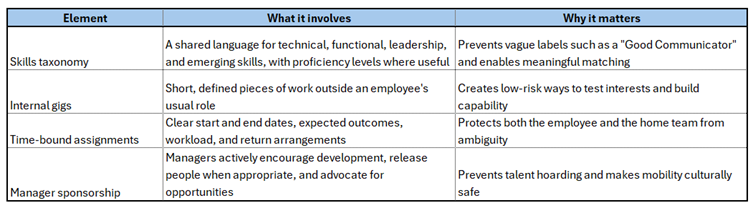
Creating a practical, rather than exhaustive, skills taxonomy is essential to align with the organisation’s overarching strategy. Start by identifying and prioritising the capabilities that most directly impact business goals. Critical skills might include areas such as project management, which ensures that initiatives are planned and executed efficiently; customer insight, which enables a deeper understanding of client needs and behaviours; data literacy, which equips employees to make informed decisions based on data analysis; coaching, which fosters a culture of continuous development; product thinking, which focuses on innovating and refining products to serve customers better; stakeholder engagement, essential for fostering collaboration and support; and digital fluency, necessary to navigate the increasingly technology-driven landscape.
To enhance clarity, each skill within this taxonomy should be accompanied by a straightforward proficiency scale, categorising development levels into stages such as: *aware*—indicating basic knowledge of the skill; *applies with support*—where individuals can execute the skill with guidance; *applies independently*—indicating proficiency in using the skill without assistance; and *coaches others*—demonstrating an advanced understanding where individuals can mentor peers. By establishing a shared language around skills, the organisation can uncover hidden capabilities across its workforce and match people to roles and projects more accurately and efficiently.
For internal gigs, assignments should reflect genuine work that produces tangible deliverables, not merely symbolic “exposure” activities. For example, a marketing analyst might lead a customer-retention initiative for a set period, while an operations coordinator could help design a new onboarding workflow. Similarly, a finance professional might support a pilot program to improve service delivery. Each internal gig requires a clear and concise brief that outlines several key elements: the overarching purpose of the assignment, the specific deliverable expected at completion, the time commitment required from the individual, the skills being sought for the project, the learning opportunities that will arise, the sponsor overseeing the gig, and the decision-making rights involved.
Establishing time-bound assignments is particularly important because it allows for reversible mobility. Employees need clarity regarding their involvement—whether they are dedicating 10 per cent, 30 per cent, or 100 per cent of their working hours to the assignment. They should also understand how their core responsibilities will be managed during this period and when they can expect to return to their original teams. By setting clear boundaries, organisations can reduce anxiety and increase managers’ willingness to endorse and participate in these initiatives. According to Deloitte, implementing talent-marketplace strategies can improve overall workforce performance, foster more agile teams, and provide tailored growth opportunities for individuals.
The Manager’s Role in Talent Mobility
Managers play a crucial role in turning a well-designed talent mobility program into a successful initiative that employees actively engage with. A program’s effectiveness hinges on managers viewing talent mobility as an essential part of their leadership role, not as a potential depletion of valuable resources.
A sponsoring manager has several key responsibilities. First, they should help employees identify assignments that meet the business’s strategic needs while aligning with the individual’s career aspirations. This requires open dialogue to understand the employee’s goals and interests.
Moreover, the sponsoring manager must set clear, achievable expectations for the assignment. This means defining roles, responsibilities, and expected outcomes so employees know what they need to do. Protecting the time employees need to complete these assignments is equally important; they must be shielded from distractions and competing priorities that can impede progress.
Providing constructive feedback throughout the assignment is another critical duty of the sponsoring manager. Regular feedback helps employees understand their performance and areas for improvement, enabling them to gain valuable insights and experience from the opportunity. Additionally, managers should celebrate the skills and capabilities employees develop during these assignments, reinforcing the value of talent mobility within the organisation.
The receiving manager also plays a significant role in this process. They need to create a meaningful, impactful position for the transferred employee and ensure they have adequate context about the work and the organisation’s goals. A fair and impartial assessment of the employee’s contributions during the assignment is essential for their growth and recognition.
To foster a culture of talent sharing, organisations should embed this expectation into their leadership framework. For instance, managers could be tasked with sponsoring at least one internal gig each quarter. This might involve releasing a capable team member for a defined period to pursue a development opportunity or identifying two employees ready to stretch themselves through broader responsibilities and experiences. Importantly, this approach does not require managers to relinquish their top talent without support; instead, it encourages a collaborative framework in which the organisation shares the costs and benefits of employee development across teams.
In conclusion, embracing the sponsor role in talent mobility not only enhances employees’ development but also strengthens the organisation by cultivating a culture of growth, collaboration, and shared success.
Benefits of Internal Mobility for People and Performance
One of the most significant advantages of promoting internal mobility within an organisation is the expedited staffing process it offers. When a team identifies a need for a specific capability or skill set, the first step can be to look internally for someone with the relevant expertise, availability, and willingness to take on the new role. This internal search is typically faster than external recruiting because the organisation already knows the employee’s work history, strengths, cultural fit, and relationships within internal networks. According to the Society for Human Resource Management (SHRM), internal recruitment processes can often be finalised within weeks, significantly minimising recruiting, training, and relocation costs.
Moreover, internal mobility plays a crucial role in enhancing employee retention. Research indicates that workers are more inclined to stay with an organisation when they can see legitimate opportunities for professional growth and development without leaving the company. Internal moves let employees gain diverse experiences, collaborate with different colleagues, learn new knowledge, and even reinvent their career paths within the same organisation. Consulting firm Mercer emphasises that these aspects are essential components of a talent marketplace, which also includes improved capacity management and higher levels of employee engagement.
Beyond retention and development benefits, internal mobility fosters a significant innovation advantage. When individuals transition across departments or functions, they bring unique perspectives. For instance, an employee from customer service may identify a gap in a digital product offering; a finance professional may have insights on optimising an operational process; a frontline team member may contribute valuable practical knowledge to a strategic project. Innovation often arises from recombining ideas—blending familiar skills in new and challenging environments—and internal mobility increases the likelihood of these innovative connections.
Lastly, fostering a culture of talent flow directly builds organisational resilience. When demand fluctuates in some areas or declines in others, organisations can redeploy existing talent and capabilities instead of relying on constant external recruitment, restructuring, or losing experienced personnel. This adaptability becomes particularly valuable in times of uncertainty, as shifting skills to align with changing organisational priorities not only preserves institutional knowledge but also provides a strategic competitive advantage in the marketplace.
Guardrails That Protect Trust in Talent Marketplaces
A talent marketplace designed to boost employee engagement and performance can falter if it becomes a way to extract more work from employees already stretched thin. To prevent this, implement design principles that prioritise performance, wellbeing, and workplace fairness.
Protect Core Performance
To maintain a healthy work environment, organisations must safeguard employees’ core responsibilities. Expecting team members to take on internal projects while maintaining their regular workload—without any adjustments—can lead to burnout and decreased job satisfaction. Therefore, organisations should establish a clear framework for time allocation. This includes defining the percentage of an employee’s time they can dedicate to an internal gig without jeopardising their primary responsibilities. Additionally, organisations may need to pause or redistribute less critical tasks to prevent employees from becoming overwhelmed. Making these trade-offs transparent will help managers and teams recognise the value of balance and support more sustainable work commitments.
Create Clear Return Paths
When employees take on temporary assignments, they need reassurance that they will not be left adrift in their career progression. Establish clear pathways to return to their original roles or advance their careers after the assignment. Organisations should clarify the nature of the temporary assignment—whether it is a project secondment, a development opportunity, a trial for a potential permanent position, or a redeployment—so employees know what to expect. Additionally, setting explicit return dates or scheduled review points can help reinforce this security. Maintaining engagement with the employee’s home manager during the assignment is also vital. Regular check-ins can ensure individuals feel supported and clear on their career trajectory, building trust in the system.
Ensure Fair Access
Access to opportunities within a talent marketplace must be equitable and free of biases that favour those with influential managers or extensive networks. To level the playing field, organisations should publish internal opportunities openly and make them accessible, using transparent selection criteria. Tracking participation metrics across diverse factors—including gender, team representation, geographic location, and career level—can help identify groups that may be consistently overlooked. If you detect disparities, take proactive measures to intervene and promote inclusivity, improving overall morale and engagement across the workforce.
Recognise Contributions Properly
Include internal gigs aligned with the organisation’s goals and strategic priorities in employees’ performance evaluations, development plans, and career discussions. Employees who take on additional responsibilities that build skills and strengthen organisational capability should not have their efforts go unnoticed. Explicitly recognising these contributions reinforces the value of internal mobility and encourages a culture where employees feel appreciated for their hard work. This acknowledgment is essential to building trust within the talent marketplace and ensuring individuals understand that their extra efforts contribute meaningfully to both their personal growth and the organisation’s success.
Measuring What Matters in Talent Mobility Programs
To evaluate a talent mobility program’s success, focus on measurable outcomes rather than simply counting how many individuals register on a platform. This approach lets organisations gauge the real impact of their initiatives on employee development and organisational performance.
Time-to-Staff: A key metric is the median time from identifying a work need to having a suitable internal candidate start in the role. By calculating this timeframe, organisations can compare internal hiring efficiency with external recruitment channels. This comparison highlights how quickly positions are filled internally and how effective internal talent visibility is.
Internal Fill Rate: Monitor the internal fill rate, defined by the Society for Human Resource Management (SHRM) as the percentage of internal positions filled out of the organisation’s total filled positions. This measure indicates how effectively the organisation uses its existing talent pool for open roles, projects, or assignments, reflecting talent mobility within the company.
Employee Engagement and Experience: To better understand employee sentiment regarding growth opportunities, access to roles, and managerial support, organisations should conduct regular pulse surveys and analyse exit interview data. This qualitative feedback can help determine whether employees see a transparent pathway for career advancement and feel supported by their managers in their professional development.
Skill Development: Track employees’ skill development throughout their tenure, noting specific skills gained, proficiency levels achieved, completed certifications, and how they apply new capabilities in subsequent tasks or projects. This quantitative data reflects the effectiveness of training and development initiatives and shows how well employees translate their learning into actual work performance.
Retention of Internal Movers: Monitoring employees who transition to new roles or complete assignments is crucial for assessing how mobility affects retention rates. Analysing retention at 6, 12, and 24 months provides insight into whether internal mobility increases employee satisfaction and loyalty within the organisation.
Manager Participation: Tracking managers’ engagement in the mobility process helps explain the organisational culture around talent mobility. This includes measuring the percentage of managers who actively sponsor opportunities (“gigs”), release talent for new projects, or post openings. Manager participation levels can show whether leadership genuinely embraces talent mobility as a core behaviour or sees it merely as an HR-driven initiative.
Metrics like time-to-fill and internal fill rate provide a solid foundation for linking talent mobility initiatives directly to operational performance. According to SHRM’s 2025 benchmarking data, the median time-to-fill for roles was approximately six weeks; meanwhile, a concerning statistic indicated that only 7 per cent of non-executive positions were filled internally. These figures underscore a significant opportunity for organisations to improve the visibility and accessibility of internal talent, thereby optimising workforce development strategies.
A Practical Next Step Towards Leveraging Internal Talent
To start using internal talent effectively, don’t begin with a sweeping technology rollout across the organisation. Instead, focus on a specific set of identified business needs. Start by selecting a small, manageable number of these needs and framing them as internal gig opportunities. This approach enables a more agile, targeted response to real business challenges.
Step-by-Step Approach
- Identify Business Needs: Conduct a thorough assessment of the organisation to pinpoint three distinct roles or specific work requirements that internal gigs could fulfil in the upcoming quarter. Consider areas where expertise is lacking or where additional support could significantly enhance project outcomes.
- Define Key Elements: For each identified role or work need, clearly outline the following components:
- Deliverable: Specify what the successful completion of the gig entails. This could be a report, a product feature, a marketing campaign, etc.
- Skills Required: List the specific skills or competencies necessary to accomplish the task effectively. This may include technical and soft skills such as teamwork and communication.
- Time Commitment: Estimate the expected time investment for participants. Detail whether it will be part-time, full-time, or a flexible arrangement.
- Sponsor: Assign a project sponsor from the management team who will oversee the gig, provide support, and ensure alignment with organisational goals.
- Employee Return Path: Outline how employees can return to their regular roles after completing their gig. This helps to promote a culture where employees feel supported in their career development.
- Publish Opportunities: Once these roles are defined, share opportunities widely across the organisation through a transparent internal opportunity platform. This exposure encourages participation and showcases a genuine commitment to employee engagement and growth.
- Pilot and Evaluate: Treat this initiative as a pilot program for a broader talent-flow strategy. Measure results over one quarter by analysing participant feedback, performance metrics, and the overall impact on the business needs addressed.
Call to Action
Embrace this pathway by engaging your teams to identify roles and establish the outlined components. By starting with tangible, meaningful work, clear leadership endorsement, and a sincere commitment to nurturing employee development, you lay the foundation for a thriving internal talent marketplace. This initiative will not only meet immediate business needs but also foster a culture of growth and opportunity within the organisation.
This Post is 18/20. Monday’s post will be: The Manager’s AI Briefing Book
