
Make Sustainability an ESG Management Lever, Not a Side Project. Organisations must recognise sustainability and Environmental, Social, and Governance (ESG) considerations as essential management levers. They should serve as actionable frameworks that help leaders make informed decisions, mitigate unnecessary risks, improve operational efficiency, and foster long-term value creation. Rather than treating sustainability and ESG as separate, charitable endeavours or mere “good corporate citizenship” projects, companies need to integrate these principles into their core business processes.
When sustainability initiatives are relegated to the sidelines—detached from core innovation and portfolio management processes—they often lack visibility and funding. In this scenario, ESG efforts may become optional, insufficiently resourced, and limited to superficial annual reporting.
In contrast, embedding sustainability and ESG into decision-making allows these considerations to play a vital role in how organisational leaders choose, design, fund, and evaluate projects. By incorporating ESG principles into everyday business practices, companies can align their operations with broader societal goals while improving responsiveness to market demands and stakeholder expectations. This integration ultimately shapes what organisations deliver, fostering a culture of accountability and innovation that drives sustainable growth.
Sustainability as a Management Discipline
In management, ESG—environmental, social, and governance—addresses a critical range of considerations organisations face today. The environmental dimension encompasses a wide range of issues vital for sustainable operations, including but not limited to energy consumption, greenhouse gas emissions, waste management, resource utilisation efficiency, and vulnerability to climate change. Each of these factors affects not only the environment but also regulatory compliance, public perception, and operational resilience.
On the social front, the focus is on aspects that directly affect stakeholders’ well-being and community relationships. Key social issues include workplace safety, product and service accessibility, customer satisfaction, labour conditions, diversity and inclusion efforts, and broader impacts on local communities. Organisations must recognise their role in promoting social equity and fostering positive community impacts, as these contribute to long-term brand loyalty and corporate reputation.
The governance aspect of ESG includes the frameworks and practices that guide an organisation’s decision-making. This includes accountability, ethical behaviour, personal data protection, integrity in procurement practices, clearly defined decision-making rights, and transparent oversight mechanisms. Strong governance ensures that a company acts in the best interests of all its stakeholders while navigating complex regulatory landscapes.
Organisations need a significant paradigm shift in how they approach sustainability. Instead of limiting the conversation to questions like, “What sustainability project should we run?” firms need to pivot toward a more integrated perspective: “How will sustainability and ESG considerations influence the quality, risk, cost, and long-term value of every project we decide to approve?” This reframing shifts ESG from a specialised side project managed by a dedicated team to a collective responsibility that permeates all levels of leadership. It becomes a central component across multiple functions, including innovation, operations, procurement, technology, product design, and human resource management.
Adopting this integrated approach makes commercial sense. When businesses prioritise ESG performance, they can strengthen strategic decision-making, improve operational efficiency, build stakeholder trust, manage risks more effectively, and drive innovation. Rather than viewing ESG initiatives as mere compliance obligations, companies can leverage these principles to deliver tangible benefits. For instance, a robust sustainability strategy can significantly mitigate risk, reduce resource costs, enhance corporate reputation, improve talent attraction and retention, and create opportunities to develop new products, services, and business models that align with changing consumer expectations and environmental imperatives.
In conclusion, the true value of sustainable management lies in its ability to create a more resilient and adaptive organisation, poised to navigate the challenges and opportunities of an increasingly complex and interconnected global landscape. Organisations that embed sustainability and ESG deeply into their core strategy will not only thrive amidst these challenges but will also contribute positively to society and the environment.
Integrating ESG into Project Decision-Making
The decisions made at the outset of a project play a crucial role in shaping its overall impact and success. When projects are approved without a thorough evaluation of their environmental, social, and governance (ESG) implications, such as carbon emissions, supplier risks, accessibility requirements, workforce impacts, and governance necessities, the potential for these issues to escalate becomes significant. Addressing these concerns retroactively is often more challenging and costly. Therefore, the objective should be to seamlessly integrate a focused set of relevant ESG criteria into the existing decision-making framework, which typically considers strategic alignment, customer value, feasibility, financial returns, and delivery risks.
Proposed Evaluation Criteria
To support this integration, a scoring model can evaluate each project proposal against a range of criteria on a 1–5 scale. These criteria might include:
Strategic Alignment: How well does the project align with the organisation’s long-term goals and mission?
- Customer or Community Value: What value does the project bring to customers or the larger community, especially concerning social impact?
- Revenue, Savings, or Productivity Potential: Will the project contribute positively to the organisation’s financial performance or enhance operational efficiency?
- Delivery Feasibility: Is the project realistically achievable within the proposed timelines and resource allocations?
- Financial and Operational Risk: What are the associated risks from both a financial and operational perspective, and how can they be mitigated?
- Environmental Impact and Resource Efficiency: What are the project’s implications for carbon footprint, resource usage, and overall sustainability?
- Social Impact, Inclusion, and Accessibility: How does the project support social equity and accessibility for diverse populations?
- Governance, Privacy, Ethics, and Supplier Risk: What governance frameworks are in place, and what risks are associated with suppliers and data management?
Not every criterion will matter equally across all sectors. For instance, a company involved in resource-intensive industries may prioritise criteria related to carbon output, energy consumption, and material usage. Conversely, a digital service provider might focus more on accessibility, customer data privacy, data governance, and equitable customer outcomes. The key takeaway is that ESG factors should be consistently considered and compared alongside traditional financial and strategic metrics, rather than relegated to an afterthought evaluated only after selection.
Ongoing Portfolio Reviews
Subsequent portfolio reviews are critical to reassessing the assumptions underlying each project. A project that seemed to present a strong sustainability case early on may later indicate increased energy demands, the engagement of high-risk suppliers, gaps in accessibility provisions, or deficiencies in data management practices. Regular reviews empower organisational leaders to make informed decisions about project redesigns, pauses, redirections, or, if necessary, cancellation before costs and risks escalate.
Integrating ESG considerations into early and ongoing decision-making is most effective when it serves as a proactive tool that guides choices and strategic adjustments, rather than merely providing retrospective documentation after delivery. Research on portfolio management consistently supports using ESG scoring and assessment tools as practical mechanisms for evaluating environmental, social, and governance impacts during project decision-making.
Implementing ESG in Everyday Practices
Integrating Environmental, Social, and Governance (ESG) principles into daily operations does not require every team member to become an expert in sustainability reporting. Instead, focus on empowering managers to translate overarching ESG commitments into specific, actionable practices that can be seamlessly integrated into their teams’ workflows.
Setting Supplier Standards
A practical starting point for embedding ESG principles is establishing supplier standards. Procurement and project management teams should develop clear minimum expectations for suppliers concerning various critical areas, including legal compliance, labour practices, workplace safety, ethical conduct, data security, environmental performance, and due diligence related to modern slavery, when applicable. When selecting suppliers, it is imperative to assess the total value they bring and the total risks they may pose, rather than simply choosing the lowest initial price. For instance, a less expensive supplier may lead to higher overall costs if they exhibit poor labour practices, resulting in disruptions, quality issues, privacy violations, or even reputational damage.
Carbon-Aware Operations
Another essential component of ESG integration is developing carbon-aware operational strategies. This approach involves managing key variables such as energy consumption, travel, material use, logistics, equipment lifecycle, and waste production. Teams can adopt strategies to enhance sustainability, such as adopting energy-efficient technologies, minimising unnecessary cloud storage and data transfers, extending the lifespan of existing equipment, consolidating deliveries to reduce transportation emissions, minimising travel by opting for remote meetings when feasible, and redesigning processes to eliminate waste. These activities not only support emissions-reduction goals but also improve overall operational efficiency. The synergy between environmental improvements and disciplined operational practices often leads to the most effective ESG-oriented management.
Inclusive Design Principles
Moreover, inclusive design plays a crucial role in ensuring that products, services, systems, and communications serve a diverse audience from the outset. This includes ensuring accessibility for individuals with disabilities, using clear, straightforward language, creating adaptable digital interfaces, and using culturally sensitive communication methods. Inclusive design should be viewed as both a social responsibility and a functional necessity, as it can significantly enhance usability, minimise revisions, broaden the potential customer base, and prevent exclusionary user experiences.
Governance by Design
Governance by design is also vital in any innovation initiative. Every project should clearly articulate decision ownership, the evidence supporting the proposed actions, mechanisms for managing conflicts of interest, potential privacy or ethical risks, and metrics for measuring outcomes. Effective governance is crucial in ensuring that ESG commitments are specific, actionable, and not merely performative. By establishing traceable commitments and assigning accountability, leaders are better equipped to explain the rationale behind selecting particular projects, fostering transparency and trust within the organisation.
The Business Case for ESG Integration
The rationale for integrating Environmental, Social, and Governance (ESG) factors into business practice is multifaceted and does not hinge on a singular, guaranteed outcome. The benefits realised from ESG initiatives can vary significantly based on an organisation’s industry context, operating model, current performance, and its ability to translate strategic commitments into action. Despite these variations, ESG considerations can enhance business value through several interconnected pathways.
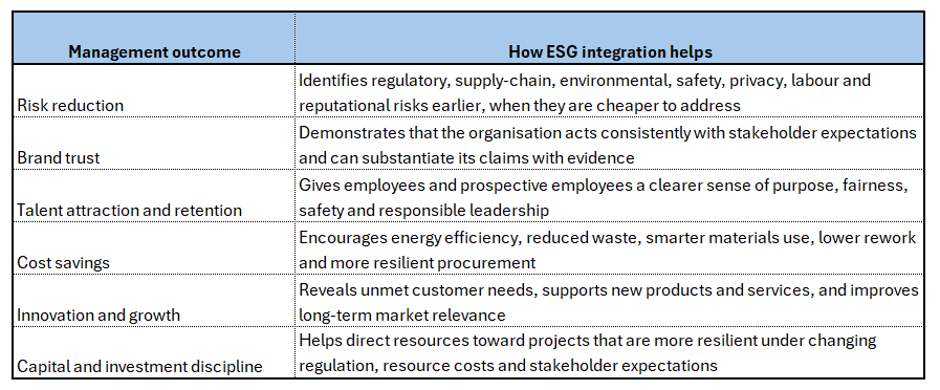
According to McKinsey, there are five primary avenues through which ESG can positively impact cash flow:
- Supporting Top-Line Growth: ESG initiatives can drive revenue growth by aligning products and services with consumer preferences for sustainability.
- Reducing Costs: Implementing ESG strategies often leads to operational efficiencies that can lower expenses across the board.
- Limiting Regulatory and Legal Interventions: Proactively addressing ESG factors can mitigate the risk of costly legal battles and regulatory fines.
- Enhancing Employee Productivity: A commitment to ESG principles fosters a positive workplace culture, which in turn boosts employee morale and productivity.
- Improving Investment and Capital Expenditure Decisions: ESG criteria can guide organisations in making wiser investment choices that consider long-term sustainability alongside financial returns.
Moreover, thorough ESG reporting and measurement can uncover opportunities for operational efficiencies, cost savings, and the exploration of innovative business models.
For managers, the key takeaway is quite straightforward: adopting an ESG perspective enriches strategic inquiries. Instead of approving projects solely based on the promise of immediate financial returns, organisational leaders are encouraged to evaluate whether these initiatives create genuine value without imposing hidden costs on customers, employees, communities, future operations, or the organisation’s reputation. This broader approach not only improves decision-making but also aligns business practices with wider societal and environmental goals.
Utilise an Effective ESG Scorecard
Implementing a streamlined Environmental, Social, and Governance (ESG) scorecard is essential for organisations that want to integrate sustainability into operations without overwhelming teams. The scorecard must strike a balance: it should be straightforward enough to encourage regular use while avoiding complexity that might make teams view it as an additional reporting burden. By linking the scorecard directly to specific team objectives, organisations can integrate ESG considerations into their customary performance evaluations, which typically include metrics such as revenue growth, customer satisfaction, milestone achievements, quality control, risk management, and cost efficiency.
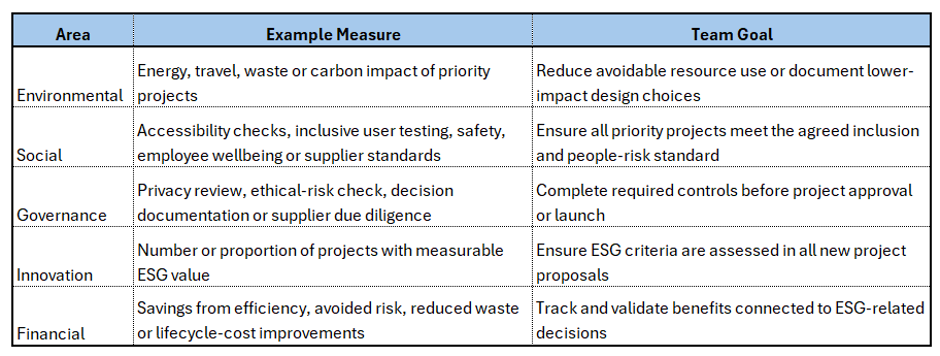
Key Components of a Basic Quarterly Scorecard
To create an impactful quarterly team scorecard, include visual elements, such as graphs, to help teams quickly understand trends and outcomes. Important components might include:
Key Performance Indicators (KPIs): Establish clear, quantifiable ESG objectives that the team can strive to meet. These should align with the company’s overall goals and reflect significant environmental and social impacts.
Team Reflections: Incorporate questions that foster critical thinking and management discussions, such as:
- What specific changes did we implement this quarter?
- What risks were we able to mitigate through our actions?
- What trade-offs did we make between competing priorities, and how did we reach those decisions?
- Who are the stakeholders that benefited from our initiatives?
- What evidence can we provide to support the results we claim?
The primary goal of this scorecard is to stimulate constructive dialogues around ESG practices rather than merely chasing easy numerical targets.
Practical Application Example
For instance, consider a project team responsible for developing a new online customer service platform. Beyond the standard metrics of cost, speed of service, and customer conversion rates, the project intake form can be expanded to prompt the team to consider several critical factors related to ESG:
- Accessibility Needs: Teams should evaluate the requirements for making the service inclusive for all potential users, including those with disabilities.
- Digital Energy Consumption: Estimate the anticipated energy demands of the new services and explore ways to minimise the digital footprint, such as optimising server usage or emusing
- Privacy and Data Handling Protocols: Ensure the design meets stringent data protection regulations and respects user privacy to foster customer trust.
- Equity Considerations: Assess whether the new service might inadvertently disadvantage customers who have limited access to digital tools or devices, and outline strategies to bridge that gap.
While these prompts will not automatically eliminate every potential issue or challenge, they will significantly improve the quality of the project brief by prompting more thoughtful planning and decision-making before committing financial resources, time, and the organisation’s reputation to the initiative. By embedding these considerations into routine practices, teams can cultivate a more sustainable and socially responsible approach to their operations.
Put it into Action
Rather than waiting for a comprehensive sustainability program, a new reporting platform, or the perfect set of performance metrics, take proactive steps by changing just one management routine.
Consider enhancing your project intake process by incorporating an Environmental, Social, and Governance (ESG) criterion right away. For instance, add the following question to your project intake form: “What material environmental, social, or governance benefit, risk, or trade-off does this project create, and what specific strategies will the team use to measure or manage these aspects?”
By including this single, impactful question, you send a clear message that responsible innovation is integral to how projects are assessed and executed. It emphasises that considering ESG factors is not merely an afterthought or an optional component, but a fundamental part of the evaluation process from the very beginning. This shift not only guides project teams to prioritise sustainability and responsibility but also establishes a culture that recognises the importance of these considerations in driving meaningful change within the organisation.
This Post is 17/20. Tomorrow’s post will be: Talent Marketplaces: Unlock Internal Mobility
