
From Controller to Coach: The Supermanager Playbook. In today’s era of artificial intelligence, leadership has become even more crucial, even as low-value management tasks become more visible. With AI’s ability to efficiently summarise reports, track progress, draft updates, and identify patterns, traditional management practices that focus strictly on oversight risk becoming obsolete. Managers who immerse themselves in activities like constantly checking, chasing after team members for updates, and approving every little task may find themselves serving as expensive bottlenecks within their organisations.
To thrive in this new landscape, the modern manager must evolve from a traditional controller of activities to a developer of capability within their team. This transformation lies at the heart of the Supermanager concept: a leader who leverages technology effectively to minimise administrative burdens and streamline processes.
By employing advanced tools and systems, Supermanagers can free up valuable time that would otherwise be spent on mundane tasks. This gives capable team members the autonomy they need to take initiative and make decisions within their roles. Furthermore, these leaders foster an environment that encourages responsible experimentation, where team members can innovate and learn from successes and failures.
The time reclaimed from minimising administrative tasks is then reinvested into crucial areas such as coaching, strategic planning, and exercising sound judgment. By focusing on developing their team’s skills and capabilities, Supermanagers not only enhance overall performance but also create a more engaged and empowered workforce. This shift from a controlling management style to one that emphasises coaching and support is essential for navigating the complexities of the modern workplace.
Why Command-and-Control Management Fails
The traditional command-and-control management approach assumes managers must retain complete control over information flow, decision-making, and oversight of work processes. While this hierarchical model may have worked in stable, predictable environments where tasks and outcomes were consistent, it falters in today’s dynamic, rapidly evolving business landscape. Teams now frequently face rapid technological change, fluctuating customer demands, and shifting market conditions, all of which require a more adaptive, responsive management style.
The rise of artificial intelligence (AI) only highlights the limitations of this command-and-control model. With the advent of various AI tools, employees can independently access essential information, explore options, and complete routine tasks without waiting for managerial approval. This newfound autonomy can boost efficiency and innovation, but it stalls when managers cling to the outdated notion that they must approve every decision. When managers insist on being the sole decision-makers, teams cannot reach their full potential and miss opportunities for better collaboration and creativity.
Moreover, excessive managerial control not only slows down processes but also cultivates several predictable and detrimental outcomes:
Decision Delays: Important decisions tend to stagnate as they await managerial input rather than being made promptly by those closest to the work. This bottleneck can hinder productivity and responsiveness.
Reduced Agency: Employees become conditioned to seek permission for every action instead of exercising their judgment. This reliance on managers stifles initiative and can foster a culture of compliance rather than innovation.
Concealed Uncertainty: Team members may feel pressured to mask their uncertainties or challenges for fear of criticism when attempting new approaches. This creates an environment that discourages exploration and learning.
Ineffective Meetings: Team meetings often devolve into reporting rituals rather than serving as collaborative forums for decision-making and shared learning. This reduces engagement and the potential for valuable discussions.
Manager Overload: Managers become overwhelmed with coordination tasks, leaving little time to focus on strategic planning and guidance. Consequently, their effectiveness as leaders is diminished.
Administrative Burdens: While AI can streamline administrative tasks, it does not automatically enhance leadership capabilities. An overemphasis on control can lead to a management rut where strategic vision is sacrificed for micromanagement.
The implications of command-and-control management extend beyond operational inefficiencies; they can also undermine team members’ sense of ownership. When employees feel they must continually prove their worth by being “busy” in their managers’ eyes, they may prioritise activity over meaningful productivity and outcomes.
To overcome the pitfalls of command-and-control management, the focus should not be on eliminating accountability but rather on redistributing it. A capable team should understand its objectives, have well-defined boundaries, and possess clear decision-making rights. At the same time, individuals should have the autonomy to determine the most effective ways to achieve the agreed-upon results. This shift not only fosters a more empowered work environment but also cultivates a culture where accountability is intrinsic and aligned with a shared vision for success.
Defining the Supermanager
The concept of a Supermanager represents a significant evolution in leadership style, moving away from traditional approaches that prioritise control and unilateral decision-making. Instead, a Supermanager is focused on cultivating an environment where team members can think critically, act with accountability, and engage in continuous improvement. This role encompasses three key responsibilities that together foster a more dynamic and effective team culture.
Empowering the Team
The first responsibility of a Supermanager is to empower the team. Empowerment involves more than delegation; it requires clearly articulating the purpose behind the team’s work and explicitly defining what success looks like. A Supermanager makes decision boundaries transparent, ensuring that each team member understands their level of autonomy. They communicate which decisions can be made independently, which require consultation, and which are critical enough to require escalation to higher levels of authority. By clarifying these boundaries, team members are not only motivated to take initiative but are also equipped with the confidence to make sound decisions. This empowerment fosters ownership and accountability, driving engagement and productivity.
Fostering Experimentation
The second responsibility centres around fostering a culture of experimentation. A Supermanager recognises the importance of innovation and encourages the team to explore new tools, workflows, and ideas without fear of failure. This approach requires a safe environment where experimentation is seen as a valuable process rather than a risk. A successful Supermanager designs experiments with defined objectives, limited scope, and designated review points. This structured approach frames failures not as setbacks but as critical learning opportunities that provide valuable insights. By promoting a mindset where experimentation is normalised, the Supermanager enables the team to adapt and evolve, ultimately driving better outcomes.
Leveraging AI for Enhanced Leadership Capacity
The third key responsibility of a Supermanager is to use artificial intelligence effectively to enhance leadership capacity, not replace it. AI technologies can streamline administrative tasks such as preparing meeting notes, identifying recurring issues, drafting communications, organising information, and automating repetitive functions. By utilising AI to handle these time-consuming tasks, the Supermanager can free up time to focus on areas that require distinctly human attributes, including coaching team members, building relationships, engaging in strategic thinking, and reflecting on ethical considerations.
Moreover, investing this reclaimed time in developing future leaders becomes essential. Recent management research and practical evidence suggest that AI’s true value emerges when it supports—not supplant—meaningful human interaction. This balance ensures that while administrative efficiencies are achieved, the critical connections that foster team cohesion and growth are not lost.
Asking the Right Questions
The Supermanager fundamentally shifts the nature of inquiry within the team. Rather than adopting a controlling mindset characterised by the question, “How do I ensure everyone is doing what I instructed?” the Supermanager takes a more constructive, supportive approach. They ask, “What does this team need to make informed decisions and deliver valuable outcomes?” This shift in questioning indicates a commitment to understanding the team’s needs, fostering the right conditions for success, and ultimately enabling the team to thrive in a collaborative environment.
In summary, the Supermanager embodies the principles of empowerment, experimentation, and the smart use of technology, guiding the team towards a future marked by continuous improvement and meaningful success.
The Five Leadership Shifts
1. Autonomy over control
In traditional management styles, control is often prioritised, which emphasises oversight of tasks and activities. This can manifest in managers who meticulously question their team members about their processes. For instance, controlling managers might ask pointed questions such as:
- “Have you completed each step of the project?”
- “Why did you choose this particular approach to tackle the issue?”
- “Can I approve this before you move forward with the next phase?”
On the other hand, a managerial approach that values autonomy encourages individuals to take ownership of their work and responsibilities. Instead of micromanaging, the focus shifts to empowering team members and building confidence in their decision-making. A manager who fosters autonomy might ask:
- “What specific outcome are you responsible for in this task?”
- “What different options have you considered in reaching this outcome?”
- “Based on your analysis, what decision do you recommend?”
- “What support or information do you require to proceed confidently?”
It’s essential to clarify that autonomy does not equate to a lack of guidance. Instead, it means setting clear expectations and defining decision rights without constant supervision. To effectively build autonomy within a team, managers should define four crucial elements:
- The outcome that the team is expected to achieve.
- The constraints and parameters within which they must operate.
- The decisions that the team can make independently, without seeking prior approval.
- The circumstances under which escalation to higher management is necessary.
For example, a content production team may exercise autonomy by selecting article structures, using varied research methods, and setting publishing schedules, all within an agreed-upon editorial strategy. However, they may still need managerial approval for legal claims, major brand changes, or significant budget increases. This structured approach lets the manager maintain accountability for the overall system while giving the team greater ownership of their work. As a result, decision-making speeds up because team members no longer have to wait for approvals on routine matters.
2. Learning over Directing
The traditional directing style tells team members what to do, often providing answers immediately without fostering deeper understanding. In contrast, a learning-oriented approach emphasises critical thinking and self-sufficiency. A directive manager might quickly offer solutions, while a coaching manager would begin by asking thought-provoking questions, such as:
- “What specific goal are you trying to achieve?”
- “What actions have you already attempted to reach this goal?”
- “What evidence or data supports your current perspective?”
- “What do you perceive as the main risk in this scenario?”
- “If you had to make a decision today, which option would you pursue?”
- “What valuable lessons did this experience impart to you?”
These inquiries don’t signify avoidance of leadership. Instead, they show the importance of directing selectively when necessary—especially when safety, ethics, urgency, or specialised knowledge is involved. This approach transforms the work environment into one focused on continuous learning, where team members view their tasks as opportunities for development. For example, upon completing a project, the team should not only evaluate whether they met the deadline but also analyse:
- Which assumptions were validated?
- Where did the team encounter rework?
- Which decisions were prolonged unnecessarily?
- What successful strategies should we replicate?
- What processes require adjustment for future projects?
- Which skills or capabilities need further enhancement?
This reflection turns standard work processes into an ongoing cycle of learning and development. By exemplifying their own learning journeys through experimentation, missteps, and adjustments, managers can cultivate an environment where employees feel safe and encouraged to share their learning experiences rather than feel compelled to portray an image of infallibility.
3. Innovation over Maintenance
A maintenance-focused mindset prioritises keeping existing processes running as they always have. In contrast, innovation questions the need for these processes and explores their relevance in the current context. Many teams become burdened by inherited meetings, reports, and approval processes that might have served a useful purpose in the past but now take time without yielding meaningful improvements. A Supermanager advocates for regular evaluations by asking critical questions such as:
- “What specific problem does this process address?”
- “Does this process continue to address that problem effectively?”
- “Could an asynchronous update serve as a more efficient alternative to this meeting?”
- “Can we leverage AI to streamline information gathering?”
- “Does this approval process genuinely safeguard quality, or is it primarily maintaining hierarchical structures?”
- “What small-scale experiment could we undertake to explore a more effective approach?”
Innovation doesn’t require sweeping changes; it can start with low-risk initiatives. Here are some examples:
- Replace a routine status meeting with a concise written update over a two-week trial.
- Use AI to draft a preliminary version of a weekly report to speed up the process.
- Create a shared repository for prompts to enhance routine research efficiency.
- Pilot a shorter decision-making meeting focused on specific decisions required.
- Encourage team members to suggest workflow improvements at the end of each sprint.
Every experimental initiative should have a measurable outcome. For example, when altering a meeting format, the team could assess factors such as hours saved, decisions made, unresolved obstacles, and overall delivery times. In AI-assisted workflows, the metrics might include accuracy levels, time saved in editing, turnaround speeds, and the volume of errors necessitating correction. The goal is not to use AI for its own sake, but to improve the quality, speed, and educational value of the work.
4. Technology-to-Outcome Bridging
In many instances, a technology-focused manager will ask, “Which AI tools are currently available?” In contrast, a Supermanager’s perspective shifts the conversation towards outcomes—specifically, “Which critical outcomes could these tools assist us in improving?”
This distinction is crucial to prevent teams from mistaking activity for genuine progress. An employee can use a variety of AI applications while still making no substantial strides in core areas such as customer satisfaction, rework reduction, or improved decision-making.
The role of a manager therefore expands to connect technological tools with operational or strategic results that matter. For instance, a manager might explore how AI-driven analytics tools can provide actionable insights to enhance customer experiences, or how automation can streamline repetitive tasks, freeing the team to focus on high-impact activities.
By fostering these leadership shifts, organisations can promote a more dynamic work culture characterised by autonomy, continuous learning, innovative thinking, and effective use of technology towards impactful outcomes.

The bridge between technology and achieving desired outcomes hinges on addressing three fundamental questions that guide the implementation of technology in decision-making processes:
What problem are we solving?
Clearly defining the problem at hand is essential. It requires an in-depth understanding of the issue, including its context, impact, and the stakeholders involved. This clarity helps align technological solutions with the organisation’s specific needs.
How will we know whether the change helps?
Establishing metrics and benchmarks is critical to assess the effectiveness of implemented changes. This may involve setting key performance indicators (KPIs) before introducing a solution and systematically evaluating results after implementation. Gathering both qualitative and quantitative data will help measure success and inform future decisions.
Where must a human review, approve, or override the result?
Recognising technology’s limits is vital for responsible implementation. Identifying key junctures where human intervention is necessary ensures accountability and mitigates risks associated with automated decisions. Determining these points involves understanding the consequences of decisions and when human insight or ethical considerations are needed.
Beyond these fundamental questions, managers should develop team agreements focused on responsible AI use and decision-making practices. These agreements can encompass several critical areas, including:
Approved Tools: Specifying which AI tools and technologies are permissible for use within the team to maintain consistency and reliability in outputs.
- Confidential Information: Outlining protocols for handling sensitive data to protect privacy and comply with regulations.
- Disclosure Requirements: Clarifying when and how to disclose the use of AI in decision-making processes, both internally and externally.
- Human Review: Defining the criteria for when human oversight is necessary, ensuring that automated outputs are subject to scrutiny by knowledgeable personnel.
- Error Reporting and Accountability: Setting mechanisms for reporting mistakes or failures, fostering a culture of learning from errors rather than placing blame.
- Implementing these practices keeps responsibility firmly in human hands, preventing technology from becoming a convenient excuse for lapses in judgement or oversight.
Coaching Conversations Over Annual Reviews
Traditional annual reviews often fail to provide timely feedback and ongoing performance development. Waiting months to learn about behaviour that might hinder effectiveness, or to recognise a valuable opportunity, can lead to missed chances for growth. Instead, the focus should shift to regular coaching conversations that promote continuous development and stay relevant in a fast-paced work environment.
Coaching conversations are structured yet adaptable, allowing for effective communication about performance and development. A successful coaching conversation typically progresses through five stages:
- Observe: Start with an observation of specific behaviours or outcomes without exaggeration or judgments. This sets a neutral tone and focuses on facts, not opinions.
- Explore: Invite the employee to share their perspective on the situation, encouraging them to articulate their thoughts and feelings regarding their actions and outcomes.
- Reflect: Collaboratively analyse the underlying causes, assumptions, and potential consequences. This reflective process helps both parties understand the complexities involved.
- Choose: Together, agree on a specific action plan or experiment that the employee can implement moving forward. This empowers the individual to take ownership of their development.
- Follow Up: Meet again to discuss what happened after the agreed action. This ongoing dialogue reinforces commitment to development and highlights areas for further improvement.
For example, a coaching conversation might unfold as follows:
“I noticed that the last two project decisions were sent back to me for approval, even though they fell squarely within your area of expertise. How did you feel about your decision-making process on those? What additional information or authority would enable you to handle these decisions independently in the future?”
This type of dialogue effectively addresses the issue without placing blame, fostering an environment where the employee is treated as a capable professional, rather than merely a task recipient.
While annual reviews remain a useful tool for formal documentation and broader evaluations, they should not be the first instance of feedback; instead, they should reinforce and summarise an ongoing dialogue centred on growth and development.
The Practical Toolkit for Effective Leadership
Establishing a Consistent Weekly Coaching Cadence
Implementing a structured weekly rhythm can significantly enhance a manager’s effectiveness, helping them shift from reactive supervision to proactive, deliberate leadership. This toolkit outlines a comprehensive approach to weekly coaching that aligns team efforts with organisational goals.
Monday: Clarifying Priorities
At the start of each week, set aside time to clarify and confirm the team’s key priorities and outcomes for the coming days. This session should involve not only identifying the most crucial tasks but also discussing dependencies that may affect progress, potential risks to address, and significant decisions that may arise. Encourage open dialogue to ensure that all team members are aligned and understand their roles in achieving these priorities. This step sets a foundation for a productive week ahead.
Throughout the Week: Observing and Supporting
During the week, take a proactive approach in observing the team’s workflow. Watch for areas where work slows, where team members frequently seek approval for minor decisions, and where their efforts don’t align with expected outcomes. Utilise AI tools to gather insights and analyse patterns based on performance data, but make it a point to cross-verify significant findings through personal assessment. Your presence and support during this phase are crucial; make yourself available to assist team members and provide guidance as needed.
Midweek: Conducting Focused Coaching Conversations
Schedule brief, focused coaching conversations with individual team members or in small groups. These meetings should emphasise progress made, decision-making processes, obstacles faced, and lessons learned rather than rehashing a lengthy list of status updates. Structure these conversations to encourage openness and critical thinking, allowing team members to express their challenges and achievements. Foster a culture of continuous improvement by highlighting both successes and areas for growth.
Friday: Reviewing Learning and Next Steps
Conclude the week with a review session where the team reflects on what has progressed, what remains unresolved, and the insights gained. This is an opportunity to document key decisions, assign ownership to follow-up actions, and celebrate experimentation—even when it doesn’t lead to immediate success. Acknowledge efforts to innovate and learn from experiences, reinforcing the idea that both successes and missteps are valuable for team development.
- One-to-One Coaching Session Structure – To enhance the effectiveness of one-on-one coaching sessions, consider following this structured format:
- What progress are you most pleased with? – Encourage the employee to reflect on their achievements and identify what has positively impacted their work.
- What is currently slowing you down? – Provide a safe space for them to discuss challenges and obstacles they are encountering.
- Which decision or conversation needs attention? – Help them pinpoint critical issues that require resolution or further deliberation.
- What have you learned since our last discussion? – Foster a growth mindset by prompting them to articulate key takeaways from recent experiences.
- What will you do next? – Guide them in setting actionable steps to move forward effectively.
- What support do you need from me? – Make it clear that you are there to provide guidance and resources as they navigate their challenges.
Managers should resist the temptation to turn every coaching session into a problem-solving forum. Sometimes, the most impactful contribution you can make is to help employees think critically about their situations and make sound decisions independently.
Implementing a Decision-Rights Matrix
To enhance clarity and reduce ambiguity within the team, consider implementing a decision-rights matrix. This tool clarifies roles and responsibilities for decision-making authority and prevents unnecessary escalation. It need not be overly complex; a straightforward matrix outlining who owns which decisions can create a transparent, efficient decision-making process. This clarity empowers team members to act confidently within their authority, streamlining workflows and enhancing overall productivity.
By incorporating these strategies into your weekly routine, you can foster an environment of engaged leadership and cooperative team dynamics, ultimately driving success in achieving organisational objectives.
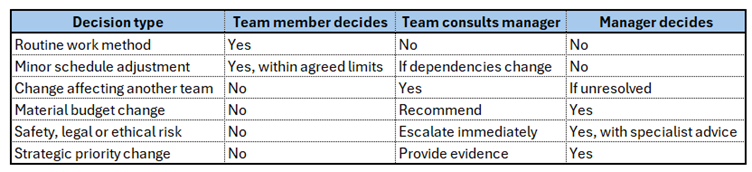
The matrix should include a time limit for escalation. A team member should know not only who makes the decision but also when to raise it and what information to provide.
A useful decision brief contains:
- The decision required.
- The recommended option.
- The evidence supporting it.
- The principal risks.
- The consequences of delay.
- The decision owner.
- The date by which a decision is needed.
- This format encourages people to bring judgement rather than bring problems.
An In-Depth Checklist for AI Task Automation
Before embarking on the journey to automate a task using AI, it’s crucial to conduct a thorough evaluation by asking the following questions:
- Is the Task Repetitive and Clearly Defined? – Assess whether the task occurs frequently and follows a consistent process. Clearly defining the task steps will help determine whether it suits automation.
- Can the Work Be Completed Without Exposing Confidential or Sensitive Information? – Evaluate the nature of the data involved in the task. Ensure that automation does not risk disclosing any confidential or sensitive information that could lead to data breaches or compliance issues.
- What Quality Standard Must the Output Meet? – Identify the specific quality metrics that the automated output must adhere to. This includes accuracy, completeness, and any relevant industry standards that need to be maintained.
- What Potential Issues Could Arise? – Consider the various risks associated with automation. What could go wrong in the process? Identifying potential pitfalls early enables proactive measures to mitigate these risks.
- Does a Person Need to Review Every Result or Only Exceptions? – Determine whether the entire output requires human oversight or if only certain exceptions warrant further scrutiny. This will help streamline the review process and allocate resources effectively.
- Who Remains Accountable for the Final Output? – Clearly define accountability. While automation can execute tasks, it’s essential to identify who takes responsibility for outcomes, especially in case of errors or inconsistencies.
- How Will We Measure Whether Automation Creates Value? – Establish metrics for evaluating the impact of automation. This can include time savings, reduced errors, improved output quality, or better team morale. Analysing these metrics will highlight automation’s true value.
- What Will the Team Do With the Time Saved? – Consider how the time saved from automation will be utilised. If the intention is merely to add more administrative tasks, the team may achieve efficiency without enhancing overall effectiveness. It’s vital to focus on redirecting this time towards more valuable activities such as:
- Coaching team members to enhance their skills.
- Engaging in strategic planning to align future efforts with organisational goals.
- Gaining deeper customer insights to improve services or products.
- Implementing quality improvement initiatives to elevate standards.
- Developing team capabilities for long-term growth.
Caution in Sensitive Areas:
When considering automation for tasks that involve personal data, employment-related decisions, legal advice, financial judgments, safety protocols, interactions with vulnerable populations, or confidential strategic discussions, proceed with greater caution. While automation can support preliminary processes, a qualified and authorised individual must retain full responsibility for interpreting automated outputs and making consequential decisions based on them.
Final Reflection
The last point about using saved time is particularly pivotal. Focusing on transformative uses of saved time, rather than simply shifting to additional administrative tasks, can enhance team effectiveness. A strategic leader, sometimes referred to as a “Supermanager,” intentionally directs freed-up time toward high-impact activities like coaching, strategic visioning, deepening customer understanding, continuous quality improvement, and skill development. This approach ensures that automation becomes a cornerstone of not just efficiency but also enhanced organisational effectiveness.
Case Vignette: Reclaiming the Week
In an organisation with a mid-sized product and services team of roughly 40 members, the prevailing culture relied heavily on numerous recurring weekly status meetings. These meetings, intended to track progress, often became lengthy sessions dominated by team members giving detailed status updates. Unfortunately, this approach pushed critical issues to the end of the discussions, where genuine decisions and unresolved risks were often addressed hastily.
Recognising the inefficiencies, the team manager decided to conduct a comprehensive audit of the meeting structure before resorting to outright cancellations. This process involved collaborating with team members to document each meeting’s purpose, attendees, recurring agenda items, decisions, and actions. After analysing the collected data, the manager found that many updates could be communicated effectively in writing. It also became clear that several meetings duplicated information already available in the project management system.
With these findings in hand, the team embarked on implementing a series of strategic changes designed to enhance productivity and communication efficiency:
- Transitioning to Asynchronous Updates: Routine progress updates shifted to a written format, allowing team members to share status reports online without real-time meetings. This change aimed to streamline information sharing and reduce the burden of redundant meeting reporting.
- Refocusing Meeting Objectives: Meetings were restructured to serve a more meaningful purpose, specifically reserved for making decisions, addressing risks, discussing dependencies, and providing coaching. By narrowing the focus of these gatherings, the team could dedicate their time to critical discussions rather than repetitive updates.
- Defining Ownership and Next Steps: Each agenda item now required a designated owner along with a clearly defined next action. This adjustment fostered accountability and ensured every participant understood their responsibilities and the follow-up actions needed after discussions.
Additionally, the manager recognised the importance of altering their own leadership approach. Instead of prompting each team member to provide a monotonous report on their activities, the manager began asking more insightful questions centred on outcomes, obstacles faced, and key decisions made. Team members were encouraged to prepare well-thought-out recommendations before raising issues during meetings. To support this process, the manager used AI tools to help organise updates and identify recurring blockers that needed addressing.
As a result of these concerted efforts, the team experienced a remarkable 40 per cent reduction in the time spent on status meetings within the first review period. This decrease allowed team members to shift their energy from repeatedly conveying information to actively resolving dependencies, fostering collaboration, and ultimately speeding project delivery. It became clear that the improvements resulted not from less communication, but from replacing low-value reporting with better-written visibility, focused decision-making, and more purposeful conversations.
However, it is crucial to recognise that such outcomes should not be viewed as guaranteed results applicable to every organisation. The effectiveness of these changes can greatly depend on factors such as the team’s specific work dynamics, existing meeting culture, and the collective ability to sustain reliable asynchronous communication. Yet the core principle from this case is broadly relevant: eliminate meetings that primarily transfer information, and instead reinvest the reclaimed time in decision-making, learning experiences, and coaching and support for team members.
Your First Move This Week: Meeting Audit and Transformation
Step 1: Audit a Recurring Meeting: Choose one recurring meeting you regularly attend or lead. Perform a thorough audit of this meeting by documenting the following details:
- Stated Purpose: Clearly define the reason this meeting was originally established. What goals or objectives is it meant to achieve?
- Actual Purpose: Reflect on what the meeting has become over time. Does it truly align with its stated purpose, or has it evolved into something else?
- Attendees: List the individuals who regularly participate in this meeting. Consider their roles and whether they are necessary for the meeting’s objectives.
- Duration: Note how long the meeting typically lasts. Is it too long, too short, or just right for the topics discussed?
- Repeated Information: Identify any information that is consistently revisited in the meeting. Determine whether this repeated information adds value or takes up time.
- Decisions Made: Track any decisions reached during the meeting. Are these decisions actionable and beneficial, or do they often remain unresolved?
- Actions Created: Document any actions that stem from the meeting discussions. Are these actions being completed, or do they frequently go unaddressed?
Step 2: Evaluate and Consider Alternatives
Once you have completed your audit, ask yourself the following questions to reassess the necessity and structure of the meeting:
- Should the Meeting Be Cancelled? If you find that the meeting no longer serves its original purpose or provides meaningful value, consider whether it should be completely removed from your schedule.
- Is an Asynchronous Update More Suitable? Explore whether an email update or shared document could replace the meeting, allowing you to share information more efficiently without requiring real-time participation.
- Should It Be Shortened and Redesigned? If the meeting remains necessary, consider whether you can make it more efficient by shortening it and focusing more clearly on actionable decisions.
- Can It Be Converted into a Coaching Session? If appropriate, consider transforming the meeting format into a coaching session that emphasises personal and professional development.
Step 3: Redefining Status Questions for Coaching Sessions
To shift toward a coaching-oriented approach, replace traditional status-update questions with ones that foster deeper reflection and growth. For example:
- Instead of “What have you been doing?” ask, “What outcome are you working towards?”
- Replace “What challenges are you facing?” with “What is the most important obstacle in your way?”
- Change “What decisions need to be made?” to “What decision are you currently considering?”
- Swap “Did you complete your tasks?” with “What have you learned from your recent experiences?”
- Shift from “Do you need help?” to “What support would help you move forward effectively?”
- Conclude with “Will you take action before our next meeting?” instead of merely wrapping up the session.
Step 4: Implement and Measure
Don’t try to overhaul every meeting at once. Choose a meeting, implement the proposed changes, and run the experiment for a week. During this period, carefully measure the impact of the changes you’ve made.
- Track Time Saved: Quantify how much time you and participants save through more efficient meetings or asynchronous updates.
- Monitor Decisions Made: Record decisions reached during the revised meetings, noting their clarity and effectiveness.
- Identify Unresolved Blockers: Assess whether blockers previously discussed are being resolved more effectively.
- Gauge Team’s Perception: Solicit feedback from participants about their experience with the modified meeting format. How do they perceive its utility and effectiveness compared to the original format?
Conclusion
The principles outlined in this approach mark the beginning of the Supermanager playbook. This transformative process encourages you to shift your perspective: stop viewing people merely as tasks to be monitored and begin seeing them as talents to nurture. By auditing one meeting this week, minimising unnecessary reporting, and reclaiming that time for meaningful coaching conversations, you can foster a culture of growth, empowerment, and improved productivity within your team.
