
How to Give and Receive Feedback Without Becoming Defensive: Feedback stands out as one of the most valuable tools available for personal and professional growth. However, it often comes wrapped in a heavy emotional package. Many individuals react defensively, whether they are delivering feedback or receiving it. This defensiveness typically arises because Feedback can be perceived as a personal attack, triggering feelings of vulnerability and insecurity.
Understanding how to navigate feedback conversations effectively is essential. It requires fostering an environment of clarity, empathy, and purpose. When these elements are present, Feedback can shift from being a source of tension to becoming a potent catalyst for improvement and development.
To give effective Feedback, it is critical to approach the conversation with a constructive mindset. Begin by focusing on specific behaviours or situations rather than making generalised statements about the person. Use “I” statements to express your observations and feelings, which helps to minimise the chance of the recipient feeling attacked. For example, instead of saying, “You never meet deadlines,” you might say, “I noticed that the last project was submitted a day late, and this affected our timeline.”
When receiving Feedback, it’s equally important to adopt a receptive mindset. Listen actively and treat the feedback as a valuable perspective rather than criticism. Take a moment to breathe and reflect instead of responding defensively. Ask clarifying questions to understand the feedback better and show that you value the other person’s opinion. A response like, “Can you provide an example of what you mean?” demonstrates a willingness to learn and grow.
Ultimately, fostering a culture of open communication is vital for both giving and receiving Feedback effectively. Encouraging regular feedback exchanges, ensuring mutual respect in conversations, and reminding each other that the goal is improvement can all help transform Feedback into a productive and enriching process. By mastering these skills, individuals can turn potential conflicts into opportunities for growth, collaboration, and positive change.
Why Feedback Can Trigger Emotional Reactions
Feedback can elicit strong emotional responses, and recent neuroscience research helps explain why. When individuals receive Feedback, especially if it is critical, it can activate the brain’s threat response system. Studies reveal that even the mere anticipation of receiving negative Feedback can trigger the same neural pathways and hormonal reactions typically associated with physical danger.
At the heart of this process is the amygdala, often called the brain’s alarm system. When Feedback is perceived as potentially threatening, the amygdala becomes highly active, initiating a cascade of physiological responses. Stress hormones, such as cortisol and adrenaline, surge into the bloodstream, preparing the body to respond as if it were facing a genuine threat. At the same time, the prefrontal cortex, which is crucial for reasoning, decision-making, and emotional regulation, tends to temporarily “go offline.” This shutdown can lead individuals to become defensive, to withdraw emotionally, or to have difficulty comprehending the Feedback being given.
Beyond the biological factors at play, significant psychological triggers influence how Feedback is received. Researchers have identified three primary categories of psychological triggers:
Truth Triggers: These occur when Feedback is perceived as untrue or unhelpful. When individuals believe the criticism is unjustified, they can experience a strong emotional backlash, leading to defensiveness or rejection of the message altogether.
Relationship Triggers: The dynamics of the relationship between the feedback giver and receiver can significantly shape how Feedback is interpreted. If the individual feels negatively toward the person giving the Feedback or perceives them as untrustworthy, this can amplify emotional responses and heighten vulnerability.
Identity Triggers: Feedback can profoundly impact one’s sense of self. When comments challenge or contradict an individual’s self-image or core beliefs, it can lead to deep emotional distress. This type of reaction often results from Feedback that touches on personal insecurities or longstanding struggles with self-worth.
These reactions are fundamentally human and show why even Feedback meant to be constructive can feel overwhelming or threatening. Understanding these biological and psychological dynamics can help us respond to feedback more constructively and support healthier, more effective communication.
Understanding the Distinction Between Criticism and Constructive Feedback
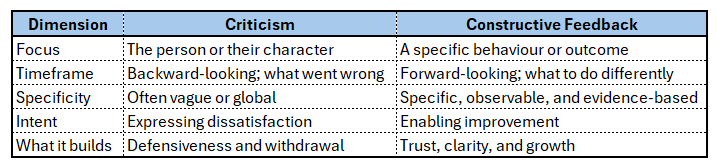
While criticism and constructive feedback may initially appear similar, they fulfil distinctly different roles in communication and personal development. Criticism primarily concentrates on identifying and emphasising what has gone wrong. It often fixates on past mistakes, assigning blame to individuals rather than addressing the specific issues at hand. This form of Feedback tends to lack clarity and can feel personal, making it more about pointing out perceived faults than providing a meaningful path forward. As a result, those on the receiving end of criticism may feel attacked and become defensive, which can hinder both personal growth and team dynamics.
In contrast, constructive Feedback is characterised by a more positive and proactive approach. It focuses on specific behaviours or outcomes rather than on the individual’s character or personality traits. Constructive Feedback is inherently forward-looking and aims to facilitate improvement by providing clear guidance and actionable suggestions. Its primary objective is to foster an environment where learning and growth are prioritised, helping individuals understand how their actions can lead to better results in the future.
Moreover, constructive Feedback seeks to build trust and collaboration rather than defensiveness. By presenting observations clearly and respectfully, it encourages open dialogue, allowing individuals to engage with the Feedback and work together towards shared goals. This approach not only clarifies expectations but also cultivates a culture of continuous improvement, which benefits both individuals and the broader organisation. In essence, while criticism can sow discord, constructive Feedback serves as a foundation for development and enhanced performance.
Using Specific Observations Rather Than Labels
One of the most effective strategies for reducing defensiveness during feedback conversations is to anchor your comments in specific observations rather than general labels or interpretations. Observations are concrete, factual details drawn from what you actually witnessed or heard, while interpretations involve your personal analysis or opinion about those observations.
For example, instead of using a judgmental statement such as “You’re careless,” which may provoke a defensive reaction, consider rephrasing it to reflect what you specifically observed: “I noticed three errors in the report’s data section.” This distinction matters because it shifts the focus from a personal character critique to a discussion of observable behaviours.
This approach keeps the conversation grounded in a shared reality, reducing the likelihood that the recipient will feel attacked. By concentrating on specific actions or outcomes rather than general traits, you create a constructive environment where Feedback can be received more openly.
Furthermore, when Feedback is detailed and backed by concrete evidence, it helps the recipient understand what transpired and what needs to be addressed. This clarity facilitates meaningful dialogue about necessary adjustments and promotes a collaborative effort toward improvement, making it easier for individuals to accept and act on the Feedback provided.
Describing Impact and Desired Outcomes
Effective Feedback goes beyond simply stating what occurred; it explains why those events matter and articulates a clear vision of what success should look like. To convey this effectively, start by outlining the impact of the observed behaviour. For instance, you might say, “When the report contained inaccuracies, it not only delayed the team’s decision-making process but also necessitated additional hours to correct the errors, which could have been avoided.”
Next, clarify the desired outcome by providing specific guidance for future actions. You could say, “In the future, I’d appreciate it if we could have the data thoroughly double-checked before submission. This proactive approach will allow us to move forward with greater assurance in our conclusions and decisions.”
Using this structure helps the recipient understand the wider context of their actions and the purpose of your Feedback. It shifts the dialogue from a critique focused solely on mistakes—”You did something wrong”—to a collaborative discussion centred on improvement and mutual success—”Here’s how we can achieve better results together.” Moreover, this approach makes feedback actionable by giving the recipient a clear, tangible target to strive for, fostering a culture of continuous improvement and teamwork.
Listening Before Explaining: The Importance of Active Engagement in Feedback Conversations
When it comes to receiving Feedback, one of the most impactful strategies you can use is active listening before formulating a response. This process goes beyond just hearing the words; it involves fully immersing yourself in the conversation to ensure you grasp the speaker’s intended message and emotional undertone.
Fully listening means letting the other person express their perspective without interrupting or interjecting your own thoughts too soon. While it’s natural to have your own opinions or reactions, holding back your need to respond right away creates a space for open dialogue. You might find it beneficial to ask thoughtful clarifying questions that encourage the speaker to elaborate. For instance, you could say, “Can you tell me more about what you observed?” or “What would success look like to you in this scenario?” These types of questions not only deepen your understanding but also demonstrate your genuine interest in their point of view.
This approach serves several critical purposes. First, it helps you understand the intent behind the Feedback, allowing you to distinguish constructive criticism from potentially hurtful comments. By focusing on understanding rather than rebutting, you minimise the risk of misinterpreting the Feedback as a personal attack. Furthermore, showing that you value the other person’s insights fosters a climate of respect and openness, which can inspire more honest and constructive exchanges in the future.
Once you have taken the time to listen and process the Feedback, you can then transition to sharing your perspective. This might involve providing context that the other person was unaware of, explaining your rationale, or even suggesting potential solutions to the issues raised. By doing so respectfully and thoughtfully, you pave the way for a collaborative, productive dialogue that can lead to positive outcomes for both parties.
In conclusion, prioritising listening before responding not only enhances your communication skills but also strengthens relationships, promotes understanding, and ultimately leads to more effective interactions.
Transforming Feedback into a Comprehensive Action Plan
Feedback is most valuable when you not only acknowledge it but actively use it to drive improvement and growth. After receiving Feedback, take a moment to reflect on what was communicated and identify specific, actionable steps you can take to address the points raised. This process can turn a simple critique into a powerful opportunity for development.
For instance, if you receive Feedback indicating that your presentations lack clarity, consider crafting a detailed action plan that incorporates multiple strategies. This could include:
Rehearsing with a Colleague: Set aside time to practice your presentation with a trusted colleague who can provide constructive criticism. This rehearsal can reveal areas where clarity is lacking and give you a chance to refine your delivery.
Simplifying Slides: Review your presentation slides to identify complex jargon or dense information that might confuse your audience. Aim for simplicity by breaking down concepts into digestible parts, using visuals effectively, and ensuring that each slide conveys one main idea.
Encouraging Audience Engagement: To foster clarity and understanding, incorporate strategies for audience interaction, such as posing open-ended questions throughout your presentation or designating time at the end for a Q&A session. This will not only help you gauge your audience’s comprehension but also make them feel more involved.
In professional environments, translating Feedback into action might also involve setting up follow-up meetings to discuss your progress and seek further insights. Document your action steps clearly, perhaps in a shared project management tool, and consider sharing this document with your manager to provide transparency and accountability.
In personal contexts, implementing feedback could mean checking in with a partner or close friend after making adjustments. Set a time to have a candid conversation about whether the changes you’ve made have positively impacted your relationship or communication.
Ultimately, the essential takeaway is to view Feedback as a catalyst for continuous improvement. By systematically addressing the Feedback you receive, you can create a culture of openness and growth, ensuring that constructive criticism is not merely a fleeting comment, but a significant stepping stone on your journey toward development and success.
In a professional context, consider a scenario where a manager addresses a recurring issue with a team member. The team member has shown a pattern of missing deadlines, which can negatively affect the entire team’s productivity and the quality of client interactions.
Rather than making a blanket accusation like “You’re unreliable,” the manager chooses a more constructive dialogue. They might say, “I want to discuss the recent project deliverables. I’ve noticed that both were submitted a day late, which delayed our client review process and increased stress for your colleagues who were counting on that work to move forward. I value your contributions to the team, and I believe addressing this can help everyone succeed. Can we work together to establish a plan that ensures we meet our deadlines? Perhaps we could set up interim checkpoints to monitor progress and identify any potential roadblocks early on?”
This approach emphasises specific behaviours and their consequences while inviting the team member to help find a solution. It promotes a collaborative, supportive atmosphere that fosters accountability and teamwork.
Personal example: Imagine a scenario where a partner feels that their spouse is not fully engaged during conversations. Instead of approaching the issue with an accusatory tone by saying, “You never listen to me,” they choose a more constructive method. They might express their feelings by saying, “I’ve noticed that when I share about my day, you often check your phone or seem distracted. This behaviour makes me feel that what I’m sharing isn’t significant to you. I value our conversations and would love for us to connect more deeply. Would you be open to setting aside 10 minutes each evening to put our phones away and talk? I believe it could really enhance our communication and strengthen our bond.”
This approach not only highlights the specific behaviour that’s been troubling but also frames it as a mutual challenge to overcome. By suggesting a concrete, positive alternative, such as having dedicated phone-free time, the partner encourages collaboration and understanding.
By adopting curiosity and clarity, and focusing on personal growth and the relationship’s well-being, potentially difficult conversations can become meaningful opportunities for connection and improvement—whether at home, in personal relationships, or in a work environment. Recognising the emotions involved and addressing them thoughtfully paves the way for deeper understanding and healthier communication between individuals.
