
From Busyness to Impact: Helping Teams Distinguish Urgent Work From Important Work. Busyness is not the same as impact. A team can be fully occupied—answering messages, attending meetings, producing reports, and responding to requests—while making little progress on the outcomes that actually matter. True impact requires more than simply staying busy; it means clearly identifying which activities move the needle on long-term goals and ensuring these are prioritised.
To achieve this, teams must deliberately separate urgent work—tasks that demand immediate attention, such as responding to emails or addressing crises—from important work, which is often less visible but advances strategic objectives, such as process improvement, learning, and prevention. Without this distinction, teams risk spending energy on tasks that feel productive but don’t create lasting value. The Eisenhower/Covey urgent-important matrix is a powerful tool in this process.
By categorising tasks based on urgency and importance, teams can make better decisions about where to invest their time. For example, urgent and important tasks require immediate action. In contrast, important but not urgent tasks—such as planning, prevention, and learning—should be scheduled and protected, not relegated to leftover time. This approach ensures that meaningful work receives the attention it deserves, allowing teams to make tangible progress toward their most critical outcomes.
Start With Team Outcomes
Before evaluating any individual task, the team must define its highest-value outcomes. These are not merely activities or deliverables, but the core results the team exists to achieve—ideally, those that would make the greatest difference to customers, stakeholders, or the organisation’s mission. For example, a support team’s outcome could be “reduce customer-impacting incidents,” which goes beyond simply closing tickets and focuses on underlying causes of recurring problems. For a product team, “increase adoption of the core workflow” shifts attention from shipping new features to ensuring that existing features deliver value and are widely used. An operations team might focus on “deliver reliable service at a predictable cost,” emphasising both stability and efficiency.
Articulate these outcomes in plain, actionable language everyone on the team can understand and remember. When outcomes are unclear or too generic, every incoming request can appear equally legitimate and urgent. This often lets the loudest voice, the most insistent stakeholder, or the nearest deadline set the team’s agenda, rather than strategic priorities. By clearly defining outcomes, the team creates a shared reference point that guides decisions and provides a basis for respectfully challenging misaligned work.
A useful exercise is to ask: “If we could accomplish only three things this quarter, what would they need to be, and how would we measure success?” Answers should be specific and, where possible, measurable—for example, reducing incident frequency by 20%, increasing daily active users by 15%, or achieving 99.9% uptime. Outcomes should also connect directly to broader goals like customer satisfaction, strategic growth, risk reduction, or operational health. This clarity helps the team filter requests and opportunities, making it easier to decide what to start, delay, delegate, or decline, and ensuring daily work adds up to meaningful progress.
Use A Shared Priority Test.
Once outcomes are defined, teams need a simple, repeatable way to assess competing work. A five-part test—customer impact, strategic alignment, risk, deadline, and effort—turns prioritisation from a matter of opinion into a structured conversation.
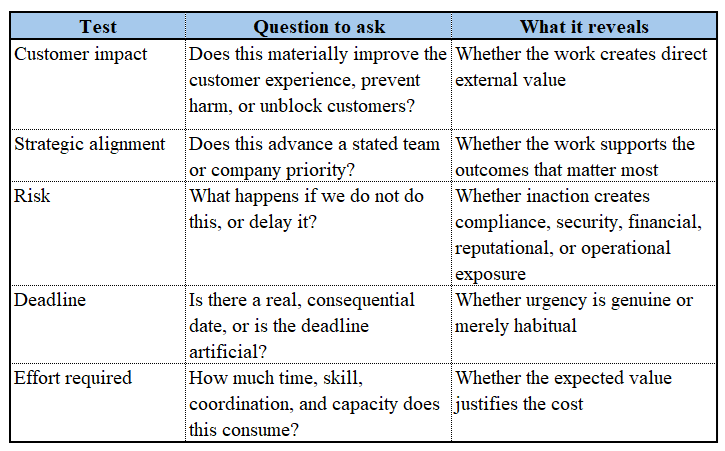
No single factor should automatically determine priority. For example, a task with an imminent deadline but minimal customer impact may still be less important than a long-term prevention project that significantly reduces risk, even if that project does not have a set deadline. Similarly, just because a task is labelled as high strategic value does not mean it should consume unlimited resources. If a proposed initiative would use a large portion of the team’s capacity but deliver only modest benefit, consider alternatives. The team should explore whether the goal can be achieved with a smaller, more focused version of the work, find a way to streamline the approach, or identify another team or individual who could take ownership, preventing resource drain and ensuring the team’s efforts are always aligned with the greatest impact.
This test also surfaces and challenges hidden assumptions about why work is prioritised. For example, when someone says, “This is urgent,” it often reflects the requester’s personal preference or visibility rather than a genuine time-sensitive consequence—such as a customer-facing outage or regulatory deadline.
Similarly, labelling something as “strategic” may mean a leader mentioned it in passing, rather than it being clearly tied to a measurable business outcome or key objective. By insisting that requests be evaluated against explicit criteria—customer impact, strategy, risk, deadline, and effort—the team can move away from subjective or political prioritisation. This structure empowers team members to question priorities constructively and ensure that decisions are based on objective value, not just who asks or how loudly.
Protect Important Non-Urgent Work
The most neglected category is usually important but non-urgent work: planning, learning, relationship-building, documentation, process improvement, maintenance, and prevention. These activities rarely create immediate pressure—there’s seldom a looming deadline to update documentation or improve a process—but they fundamentally determine whether the team operates sustainably or remains locked in a cycle of emergencies and reactive work. In the Eisenhower framework, these tasks fall into the “important but not urgent” quadrant and must be scheduled proactively, not left for leftover time or treated as optional.
Planning underpins effective execution. When teams dedicate time to plan, they clarify priorities, align expectations, and avoid wasting effort on misaligned work. This might involve quarterly offsites to set objectives, monthly reviews to adjust plans, or weekly sessions to sequence tasks. Learning is equally vital: regular skills development—such as cross-training, technical workshops, or peer knowledge-sharing—helps the team adapt to new challenges and reduces overreliance on a few key individuals.
Prevention activities, though easy to postpone, are long-term force multipliers. Addressing recurring incidents, automating repetitive tasks, refining on-call rotations, or updating process documentation all reduce future interruptions and allow more energy for strategic work. For example, investing time to fix the root cause of a frequent outage can save dozens of hours of firefighting similar incidents later. These investments pay compounding dividends over time.
Teams must build protection for this kind of work into their structure and routines, not leave it to individual discretion or wishful thinking. Teams can reserve recurring calendar blocks for planning, improvement, or deep work—such as a “no-meeting Wednesday morning” dedicated to process upgrades. Some teams set a fixed percentage of weekly capacity (e.g., 15–20%) for non-urgent but value-creating activities and track whether it is actually used as intended. Treat these blocks as seriously as customer-facing commitments, shielding them from ad hoc meetings and last-minute requests. The specific amount of time matters less than the discipline: consistently reserving capacity for important but non-urgent work lets teams break the cycle of constant firefighting and make meaningful, long-term improvements.
Make Trade-Offs Visible
Saying “we are too busy” is not the same as making a prioritisation decision. Instead, effective teams make trade-offs explicit and transparent to all stakeholders. This means clearly stating the consequences of taking on new work: for example, “We can do A and B this week, but doing both means delaying C by two weeks,” or “We will not take this request now because it would displace the customer-impacting reliability work already committed.” By quantifying the impact of choices—such as how many hours or days will be shifted, which outcomes will be delayed, or what risks will increase—teams turn vague busyness into actionable information for decision-makers.
This visibility fundamentally changes the conversation with leaders and stakeholders. When everyone can see what is being delayed or deprioritised, leaders are better positioned to decide whether the trade-off is worthwhile. They might add resources, reduce the scope of certain tasks, extend deadlines, bring in another team to share the load, or accept that a new request must wait until existing priorities are complete. Transparent trade-offs also create shared accountability: the team, leaders, and stakeholders all understand and agree to the consequences of their choices. Without that visibility, teams often absorb extra work silently, leading to missed commitments, burnout, and blame for poor delivery—even when the real issue was unacknowledged overload.
To support this, use a practical rule: no new commitment without a corresponding trade-off. Every “yes” uses up finite capacity, so teams and leaders should always ask, “What will we stop, postpone, simplify, or delegate to make room for this?” This approach isn’t about rigidity; it is about making flexibility intentional and sustainable, ensuring the most important work gets done without sacrificing the team’s well-being or long-term effectiveness.
Challenge Low-Value Work
Not all work deserves to be optimised; some work should be eliminated to free up capacity for what truly matters. Common examples of low-value work include recurring meetings that rarely lead to decisions or actions, lengthy reports nobody reads or references, approval steps that add delay without meaningful oversight, redundant or overlapping processes between teams, and routine status updates that could be handled asynchronously. Each of these drains attention and time that could be redirected toward customer value, innovation, or team development.
To systematically identify and challenge low-value work, teams should periodically conduct a “work audit” or “ritual review.” Set aside time—perhaps quarterly or during a team retrospective—to review all standing meetings, reports, approvals, and key processes. For each, ask four questions:
- Why does this meeting, report, approval, or process exist? Is its purpose still relevant?
- Who uses the output, and what decision or action does it enable? If there’s no clear consumer or business impact, the activity may be unnecessary.
- What would happen if it stopped, became less frequent, or was shortened? If there is no material consequence, consider eliminating or reducing it.
- Could you achieve the same purpose with less effort or coordination? For example, could you share information via a dashboard or written update instead of a meeting?
The goal isn’t to eliminate governance, alignment, or collaboration, but to ensure each ritual or process justifies the time and attention it costs. A weekly meeting may be justified if it consistently resolves blockers or enables key decisions; a monthly written update may be more efficient if the goal is to keep stakeholders informed. Approvals may be necessary for high-risk spending, security changes, or compliance, but unnecessary for low-risk, reversible, or routine decisions. For every activity, ask whether it tangibly improves speed, quality, decision alignment, or risk control more than it costs in time and momentum. By applying this scrutiny regularly, teams can continuously streamline operations and focus energy on work that delivers meaningful results.
Review Workload Weekly
Because team priorities constantly shift—due to changing business needs, unexpected incidents, or inaccurate estimates—a regular, structured workload review is essential to maintain focus and prevent chronic overload. A weekly review creates a feedback loop, letting the team spot misalignments early and adjust in time before small problems escalate. This is especially important in dynamic environments where new requests and interruptions are frequent.
The weekly review should be concise yet action-oriented. Instead of simply listing activities, focus the discussion on key questions: What outcomes are we aiming to achieve this week? Which workstreams are actively in progress, and which are stalled or blocked? Have any priorities shifted since last week? Is any individual or subgroup carrying too much critical-path or urgent work? What tasks could be delayed, delegated, broken down, or stopped entirely to relieve pressure and ensure focus on the most impactful outcomes?
To maximise value, treat the review as distinct from a status meeting. The goal isn’t to provide updates for visibility’s sake, but to reallocate capacity and address risks. If one team member is overloaded, the group can redistribute tasks, narrow the scope, add temporary support, or renegotiate deadlines with stakeholders. If improvement work is consistently being postponed by urgent issues, that is a signal to address systemic problems—such as insufficient planning, unclear ownership, excessive dependencies, or broken processes. Over time, this practice reduces burnout and missed commitments and helps the team learn from recurring patterns and improve how work is planned and executed.
A Robust Weekly Cadence Might Include
- Reconfirm the team’s top two or three outcomes to ensure everyone is aligned on what matters most.
- Reviewing all active workstreams against criteria like customer impact, strategic value, risk, deadlines, and required effort.
- Identifying overloaded individuals and any critical work that lacks ownership so that bottlenecks can be resolved proactively.
- Making explicit trade-offs: deciding what to start, continue, pause, delegate, reduce, or stop based on current constraints and priorities.
- Protecting time for non-urgent but important activities such as planning, skill development, and process improvement, and actively monitoring whether this protected time is honoured.
- Communicating any changed commitments to affected stakeholders promptly, so expectations are managed and trust is maintained.
- Embedding this weekly review into the team’s routine creates a culture of continuous alignment, adaptability, and transparency—key ingredients for sustained impact and healthy team dynamics.
Build An Impact Culture
Ultimately, moving from busyness to impact requires an intentional cultural shift at every level of the organisation. This starts with leaders modelling and reinforcing the right behaviours: celebrating meaningful results over mere activity and making it clear that high-impact outcomes—not visible busyness—are the true measure of success. Leaders should consistently ask, “What did this enable for our customers or business?” rather than “What tasks did you complete?” They should recognise when a team or individual thoughtfully declines or defers work to stay focused and effective, sending a powerful signal that sound prioritisation and the courage to say “not now” are valued, not penalised.
Embedding an impact culture also means fostering psychological safety, so team members feel comfortable raising concerns about low-value work or challenging priorities that don’t align with stated outcomes. It encourages ongoing learning and transparency: teams regularly discuss not just what they’re doing, but why it matters, what they’re intentionally deprioritising, and how they are protecting time for strategic, long-term activities. Teams can use visual tools—such as outcome dashboards, priority lists, or “stop-doing” lists—to make these choices clear and shared.
A true impact culture turns busy individuals into a cohesive team with a shared purpose and clear boundaries. This clarity and alignment empower the team to deliver results that matter—consistently and sustainably—while avoiding burnout and fostering pride in their collective achievements.
Tomorrow’s post will be: Capacity Planning for Managers: Saying Yes Strategically Without Burning People Out.
