
Decision Rights: Who Recommends, Who Decides, and Who Needs to Be Informed. Decision rights provide a crucial framework for answering a seemingly straightforward yet profoundly impactful question: who is authorised to make specific decisions within an organisation? When this question remains ambiguous, it often creates inefficiencies: teams spend too much time seeking approvals, leaders become overwhelmed and act as bottlenecks, and individuals feel uncertain about their ability to act.
By establishing clear, well-defined decision rights, organisations can significantly improve speed, accountability, and trust among team members. This clarity delineates roles within the decision-making process, distinguishing between those who provide input, those who make recommendations, those who ultimately make the decisions, and those who need to be kept informed throughout the process.
Such a structured approach not only empowers individuals to act with confidence, knowing their authority and responsibilities, but also fosters a culture of accountability. Team members can contribute effectively, while leaders can focus on strategic initiatives rather than getting bogged down in routine approvals, thus enhancing overall organisational efficiency and responsiveness.
The Importance of Defining Decision Rights in Organisations
In any organisation, decisions are made at various levels, each playing a critical role in the business’s overall operations and strategy. For instance, a support officer might resolve a customer complaint, ensuring concerns are addressed promptly. Meanwhile, a team leader may have the authority to approve a minor budget adjustment that impacts a specific project. At a higher level, a manager is tasked with selecting a new supplier, a decision that may influence cost management and service quality. Finally, the executive team typically makes significant strategic decisions that can affect the organisation’s long-term direction, such as entering a new market or altering the business model.
However, problems can arise when the delineation of these decision-making levels is blurry or poorly communicated. For example, a routine decision, like approving an expense report, may be unnecessarily escalated to a higher authority if employees are unsure of their own decision-making powers. Conversely, a high-stakes decision, such as approving a new strategic partnership, could be made hastily by someone who lacks the necessary authority or understanding of the implications, potentially leading to negative outcomes for the organisation. Additionally, multiple individuals may assume ownership of the same decision, leading to confusion, duplicated efforts, and delays in execution.
Establishing clear decision rights is essential not only for maintaining order but also for promoting effective collaboration within teams. When decision rights are well defined, individuals can work more efficiently, knowing who has final authority in specific situations. This clarity does not stifle collaboration; rather, it fosters purposeful interaction. Team members are empowered to consult, challenge each other’s ideas, and share relevant information. They do this knowing that while discussion and debate are encouraged, a designated individual or group holds responsibility for the final decision.
The benefits of this clarity are manifold. It reduces confusion among staff, mitigates the risk of duplicated efforts, and keeps workflows moving without unnecessary delays caused by uncertainty about decision-making. Ultimately, clear decision rights make an organisation more agile, better equipped to navigate challenges and seize opportunities efficiently and effectively.
The Four Decision Roles: A Comprehensive Overview
In the realm of effective decision-making, a nuanced model that outlines distinct decision rights has emerged, identifying four key roles that individuals or groups may play:
Input Providers: This group consists of individuals whose insights, expertise, or perspectives can significantly influence the decision-making process. They can include team members who will be impacted by the decision, specialists with relevant knowledge, or representatives advocating for customer needs, frontline staff, or various departments. Their contributions are vital to ensuring the decision is well-informed and considers multiple viewpoints and potential impacts.
Recommenders: This role is assigned to the person or group responsible for exploring, developing, and presenting options based on thorough analysis and evidence. Recommenders examine alternative solutions in detail, weigh the pros and cons, and ultimately propose a specific course of action. Although they lack the authority to make the final decision, they are accountable for the quality and robustness of their recommendations, which influence the direction decision-makers consider.
Deciders: This role is critical, as it involves the individual or group that is empowered to approve, reject, modify, or defer the proposed actions set forth by the recommenders. To keep the decision-making process clear and efficient, this role should be singular whenever feasible. Shared decision authority can create unnecessary delays and reduce clarity, ultimately complicating decision outcomes.
Informees: While these individuals do not take part in the decision-making process, they must be kept abreast of the outcomes. Informees include those who need to know the decision so they can implement it effectively, support it, or prepare to navigate any changes. Keeping this group informed helps to facilitate smooth transitions and minimises the risk of confusion or resistance later on.
For instance, when an organisation is tasked with selecting new customer-service software, the decision-making process might unfold as follows: frontline staff and IT specialists provide valuable input based on their experiences and technical knowledge, ensuring that all perspectives are considered. The operations manager, acting as the recommender, will analyse the options and suggest a preferred choice based on the insights gathered. The general manager, as the decider, will have final authority to accept or alter the recommendation. Finally, once a decision is made, finance, marketing, and customer service teams must be informed so they can adapt to and support the new software implementation seamlessly.
This structured approach clarifies roles and strengthens collaboration, ensuring all relevant voices are heard, and final decisions are well-founded and actionable.
Utilising a Simple Decision-Rights Matrix
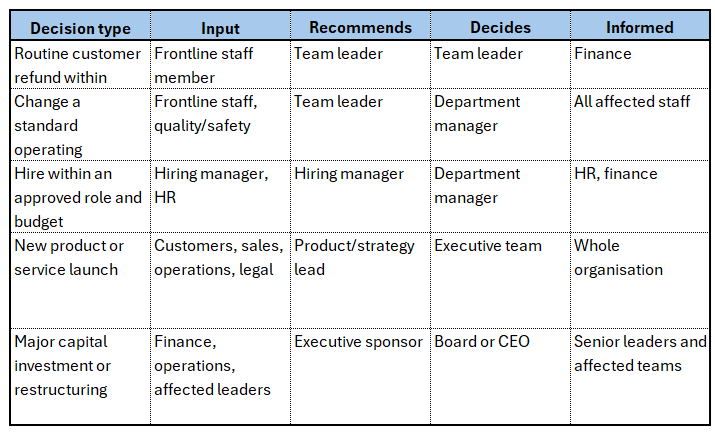
A Decision-Rights Matrix inspired by the RACI (Responsible, Accountable, Consulted, Informed) framework is a practical tool that turns abstract notions of authority into a clear, repeatable process. This matrix clearly delineates roles and responsibilities for different decision types, improving transparency and reducing ambiguity in decision-making.
In its most fundamental structure, the matrix categorises major types of decisions and aligns them with relevant roles and stakeholders, as illustrated below:
Conclusion
The Decision-Rights Matrix is designed to be concise, practical, and revisited regularly, not treated as a burdensome bureaucratic document. Its objective is to streamline decision-making by addressing the most common scenarios that often lead to confusion, delays, risks, or conflicts, enabling a more effective organisational process.
Aligning Authority with Risk and Reversibility in Decision-Making
When making decisions within an organisation, recognise that not all choices warrant the same level of scrutiny and deliberation. Routine, reversible, and low-risk decisions often benefit from a swift resolution. These types of decisions—such as approving minor expenses, resolving service issues within predefined parameters, or making adjustments to workflows—are best handled by team members who are closely connected to the operational aspects of the work. These individuals have the local knowledge and understanding to make informed choices quickly, enabling rapid adaptations that can boost productivity and responsiveness.
In contrast, decisions that carry significant financial implications, legal repercussions, reputational risks, safety concerns, major staffing adjustments, or long-term strategic commitments require a more cautious approach. These high-stakes decisions require broader consultation and involve higher-level management or specialised stakeholders. The key principle is that increased seniority does not automatically mean better decision-making; instead, decision-making authority should match the potential consequences, complexity, and difficulty of reversing those decisions.
To guide this process, a practical test can be employed: Consider the implications of a decision should it turn out to be incorrect. Specifically, evaluate how costly, visible, and challenging it would be to amend or reverse that decision. If the potential repercussions are significant or the reversal process seems daunting, engage a more deliberate, thoughtful decision-making process. This careful consideration ensures that decisions are made with the necessary gravity, thereby safeguarding the organisation from avoidable pitfalls and fostering a culture of responsible decision-making.
Empowering Decision-Making at All Levels
To build a dynamic, responsive organisation, effective leaders intentionally push decision-making authority down the hierarchy. This approach isn’t about relinquishing responsibility; it strengthens team members’ capabilities and speeds up operational efficiency. Those closest to customers, processes, and daily challenges often identify emerging issues first and are uniquely positioned to understand the real-world implications of different choices.
Implementing this strategy requires clear boundaries and decision-making parameters. It is essential for staff members to fully understand what decisions they are empowered to make independently, when it is appropriate to seek counsel from colleagues or supervisors, and when issues must be escalated to higher management. For instance, frontline employees may be granted the autonomy to offer compensatory gestures, such as discounts or replacements, within a predefined monetary limit. However, if a situation exceeds this threshold, they must refer it to a superior for further consideration. This structure balances autonomy with accountability.
When employees feel trusted and are empowered to make sound decisions, they are likely to experience accelerated learning, increased confidence in their actions, and a greater sense of ownership regarding outcomes. This empowerment not only boosts employee engagement but also lets leaders focus on strategic decisions that genuinely warrant their involvement, creating a culture of responsiveness and innovation throughout the organisation.
Enhancing Transparency in Decision-Making
In any organisation, significant decisions can greatly affect team morale and overall effectiveness. One fundamental principle of effective leadership is transparent decision-making. When individuals understand the rationale behind a decision, they are more likely to accept it, even if they may not fully agree with the outcome. Transparency should not be misconstrued as necessitating universal agreement or the inappropriate sharing of sensitive information. Rather, it involves clearly articulating the problem at hand, the various options that were considered, the evidence or data that informed the decision, the trade-offs that were made, and the reasoning behind the final choice.
To facilitate this clarity, maintaining a simple yet comprehensive decision record can be invaluable. This record should clearly outline the key elements of the decision-making process, such as:
- Decision Statement: A concise summary of the decision being made.
- Owner: The individual or team responsible for the decision.
- Date: When the decision was made or documented.
- Main Alternatives: A brief overview of the different options that were evaluated before arriving at a decision.
- Rationale: An explanation of why the chosen option was selected, highlighting the most persuasive factors.
- Expected Outcome: A forecast of the anticipated results or implications of the decision.
- Review Timeline: Dates for revisiting the decision or assessing its effectiveness.
This structured approach matters most for major commitments, such as changing organisational priorities, reallocating financial resources, starting or ending projects, and restructuring teams. By documenting these elements, organisations not only promote a culture of openness but also create a reference point for future decisions.
Moreover, transparency significantly supports organisational learning. When decisions yield positive results, teams can analyse and understand the factors that led to success, allowing them to replicate effective strategies. Conversely, when a decision does not produce the desired outcomes, teams can examine the underlying assumptions and processes, promoting accountability and continuous improvement rather than resorting to blame.
In summary, transparent decision-making proactively builds trust, deepens understanding, and supports growth within an organisation. By embracing this practice, leaders can create an environment where all members feel informed, engaged, and capable of contributing to shared goals.
Review Bottlenecks and Adjust Decision-Making Authority
As organisations evolve and individuals build their skills and capabilities, organisations must reassess and adapt the decision-rights framework. Decisions that previously required executive oversight may be appropriate to delegate to mid-level managers, reflecting growth in both the organisation and the individuals involved. On the other hand, certain decisions, particularly those with increased complexity or heightened risk, may warrant a shift back towards requiring senior leadership involvement or additional expertise.
To ensure a smooth decision-making process, leaders should engage in frequent reflection and inquiry by asking the following targeted questions:
- Which decisions are currently languishing without approval, and what is causing the delay? – Identifying decisions that are stalled can highlight inefficiencies in the approval process, pointing to potential areas where delegation could relieve bottlenecks.
- Where do we observe recurring patterns of individuals becoming decision-making bottlenecks? – Recognising individuals who are consistently overwhelmed with decision requests can help address workload issues and distribute responsibilities more evenly across the team.
- Are team members escalating decisions that they are fully equipped to make independently? – Encouraging autonomy and empowering employees to make informed decisions can streamline processes and foster a culture of accountability.
- Are there any decisions being executed without adequate oversight from experts or risk assessment? – This question prompts a review of thresholds for decision-making, ensuring that significant or high-stakes choices are informed by appropriate knowledge and insight.
- Do all team members understand the decision-making hierarchy—who has the authority to decide, who plays an advisory role, and who needs to be kept informed? – Clarity in roles and responsibilities can prevent confusion, allowing for more efficient communication and faster decision-making.
These questions should be incorporated into regular leadership discussions, such as during leadership meetings, project retrospectives, or quarterly planning sessions. The emphasis should be on maintaining a dynamic decision-making system that reflects the organisation’s current realities rather than striving for outdated or overly rigid documentation. The ultimate objective is to foster an adaptive environment that supports timely and informed decisions.
The Leadership Payoff: Enhancing Decision-Making Culture
Establishing clear decision rights within an organisation is essential to balancing control and autonomy. In this framework, leaders remain accountable for setting overall direction, assessing risks, and making strategic commitments. At the same time, teams are empowered to make decisions and act within clear, sensible boundaries. This clarity allows individuals to shift from asking, “Am I allowed to decide this?” to “What is the best decision I can make within my granted mandate?”
This mindset shift profoundly affects organisational culture. It replaces a culture of hesitation and uncertainty with one characterised by initiative and proactive decision-making. As team members no longer need to seek approval for every action, the approval queues that often slow progress are significantly reduced. This streamlining not only accelerates decision-making processes but also reinforces accountability at all levels, as individuals recognise their role in the organisation’s success.
In a well-designed organisation, the emphasis is not merely on following instructions but on exercising judgment and taking ownership of decisions. This approach encourages a culture of learning, where team members don’t just execute tasks but actively help shape outcomes. By empowering individuals to make informed decisions, the organisation benefits from diverse perspectives and greater creativity, enabling faster adaptation and better alignment with strategic goals.
Ultimately, this shift toward a more autonomous and accountable workforce enables the organisation to move swiftly while maintaining coherence in its mission and vision, enhancing overall performance and responsiveness in a dynamic environment.
Monday’s post will be: From Busyness to Impact: Helping Teams Distinguish Urgent Work From Important Work
