
How to Challenge Limiting Beliefs and Think More Flexibly: Limiting beliefs are deeply held assumptions that restrict how you view yourself, others, or what is possible in your life. They often sound like facts—such as “I am not good enough,” “I always fail,” or “It is too late for me”—but these statements are typically interpretations shaped by past experiences, thinking habits, and emotional responses.

Challenging a limiting belief does not mean replacing it with unrealistic positivity. Instead, the goal is to examine the belief fairly and develop a more accurate and flexible perspective. This new understanding should acknowledge difficulties without turning them into permanent judgments.
What Are Limiting Beliefs?
Limiting beliefs are deeply ingrained ideas that can significantly constrict your perceptions of yourself and your abilities. These beliefs often manifest as ongoing conclusions that not only limit your choices but also undermine your self-confidence. They shape the way you approach challenges, the effort you put into pursuing your goals, and your resilience when faced with setbacks.
For instance, a person might think, “I am bad at communicating,” which discourages them from engaging in conversations or situations where communication is vital. Another common example is, “Successful people are naturally confident.” This belief can keep individuals from seeking leadership or public-speaking opportunities because they feel they lack an innate quality others possess. Similarly, thoughts like, “If I make a mistake, people will lose respect for me” or “I must get everything right” can create an overwhelming fear of failure. Statements such as “Because I failed once, I will probably fail again” reflect a pattern of thinking that discourages risk-taking and personal growth. At the same time, “People like me do not achieve that kind of success” reinforces a negative self-image based on external comparisons.
These limiting beliefs often operate below the surface of conscious thought. Instead of appearing as well-reasoned conclusions, they may emerge unexpectedly as automatic thoughts, vivid images, strong emotions, or physical sensations in response to certain situations. In cognitive behavioural therapy (CBT), these automatic thoughts are scrutinised because they are often exaggerated or distorted and can stem from incorrect assumptions or past experiences.
It is important to note that a limiting belief is not always entirely false; it might contain a kernel of truth but is articulated in an overly broad or inflexible manner. For instance, someone might acknowledge that they have faced challenges with public speaking; however, the belief “I cannot speak in front of people” takes that struggle and solidifies it into an unchangeable identity, which misrepresents their potential for growth and improvement.
To effectively address and navigate these limiting beliefs, it can be beneficial to differentiate between various types of statements related to your abilities or experiences:
A fact: “I found that presentation difficult.” This recognises the reality of the situation without interpretation.
A temporary assessment: “I need more practice presenting.” This reflects a constructive view that allows for development and growth.
A limiting belief: “I am incapable of speaking confidently.” This represents a sweeping generalisation that restricts future possibilities based on past experiences.
A prediction: “I will embarrass myself every time.” This projects a negative expectation onto future experiences without evidence to support it.
The last two examples show how limiting beliefs extend beyond what one has actually experienced, often leading to self-sabotage and a failure to embrace new challenges. By recognising and reframing these beliefs, individuals can open new pathways for personal and professional development, build confidence, and expand their range of choices.
Understanding the Origins of Limiting Beliefs
Limiting beliefs are deeply ingrained convictions that can significantly restrict personal growth and potential. These beliefs often arise from a combination of repeated experiences and the meanings we assign to them. While the events themselves are impactful, the conclusions individuals draw play a critical role in forming these beliefs.
Common Sources of Limiting Beliefs
Early Messages
Childhood experiences serve as foundational building blocks for our beliefs. Messages received during formative years—such as repeated criticism, unfavourable comparisons, neglect, overprotection, or unrealistic expectations—can significantly shape one’s perception of competence and self-worth. For instance, a child who is constantly told they are not good enough academically may grow up feeling inadequate, which can affect their self-esteem and confidence in their abilities.
School and Workplace Experiences
Experiences in educational settings and professional environments can leave lasting impressions. Incidents involving bullying, public embarrassment, exclusion from peer groups, harsh evaluations, or a string of failures can lead individuals to develop a pervasive sense of rejection or inadequacy. These experiences may create a fear of failure, causing a person to avoid challenges for fear of experiencing similar hurt again.
Family and Cultural Expectations
Expectations set by family and cultural backgrounds can profoundly influence belief systems. Messages about success, gender roles, age-appropriateness, appearance standards, financial status, emotional expression, and personal responsibility can crystallise into internal rules that govern one’s behaviour and self-image. For example, a child raised in a family that values success above all else may internalise the belief that anything less than perfection is unacceptable.
Trauma or Significant Loss
Experiencing trauma or significant loss can lead to the formation of limiting beliefs that, while initially protective, can become detrimental. Individuals who have endured painful experiences may adopt beliefs such as “The world is unsafe” or “I cannot trust anyone,” which can hinder their ability to form relationships and navigate new situations.
Repeated Setbacks
Facing several disappointments over time can reinforce a cycle of negative thinking, prompting individuals to draw generalised conclusions about themselves and their capabilities. For instance, failing at a task multiple times may lead one to conclude, “I am a failure,” overlooking the fact that their circumstances may have changed or that they now have the skills to succeed.
Comparison and Social Media
The pervasive influence of social media amplifies limiting beliefs by fostering unhealthy comparisons. Individuals often see curated images of others’ successes without the accompanying struggles, leading to unrealistic standards for their own lives. This can create feelings of inferiority and inadequacy.
Perfectionism
A tendency towards perfectionism can contribute to limiting beliefs, where only outstanding performance is deemed acceptable. Individuals may interpret ordinary mistakes as evidence of failure, creating a fear of taking risks or attempting new endeavours in pursuit of unattainable standards.
Protective Learning
Some beliefs originally formulated as protective mechanisms to avoid criticism, danger, or disappointment can become limiting over time. Although these beliefs may have been beneficial in specific contexts in the past, they may hinder a person’s ability to embrace new opportunities and challenges in their present life.
Maintaining Limiting Beliefs
These limiting beliefs are often sustained through selective attention, where individuals focus on evidence that supports their beliefs while disregarding contradictory experiences. For example, a person who holds the belief “I always get things wrong” may obsessively highlight their mistakes while dismissing their successful decisions and accomplishments.
Cognitive Behavioural Therapy (CBT) identifies several patterns, commonly referred to as thinking errors, that help maintain limiting beliefs. These include:
- All-or-Nothing Thinking: Viewing situations in black-and-white terms, with no middle ground.
- Overgeneralisation: Making broad conclusions based on a single incident.
- Mind Reading: Believing one knows what others are thinking without evidence.
- Catastrophising: Anticipating the worst possible outcome in any given situation.
- Emotional Reasoning: Assuming that negative feelings reflect the truth of a situation.
- Disqualifying the Positive: Ignoring or downplaying positive experiences or outcomes.
The Path to Self-Understanding
Understanding the origins of limiting beliefs can foster self-compassion and empathy towards oneself. However, recognising where a belief originated does not automatically validate its accuracy in the present context. A belief that was once sensible in a particular environment may still be unhelpful today. Challenging and reframing these beliefs is crucial for personal growth and moving forward in a more positive, empowered manner.
Recognising Self-Critical Thoughts
The journey towards self-compassion begins with the ability to identify self-critical thoughts before automatically accepting them as truths. Often fleeting, familiar, and ingrained, these detrimental thoughts can easily go unnoticed. One primary way to catch them is to notice their emotional and behavioural impacts on your daily life.
Signs to Watch For
Pay close attention to your mental and emotional states when you notice any of the following:
Emotional Indicators: Feelings of shame, anxiety, discouragement, resentment, or hopelessness can serve as red flags that self-critical thoughts may be at play.
Behavioural Responses: You might experience a sudden urge to withdraw from social situations, procrastinate on tasks, or even give up on your efforts altogether. These behaviours can strongly indicate that a critical voice is influencing your actions.
Repetitive Thoughts: Notice if you often find yourself plagued by recurring phrases such as “I should,” “I always,” “I never,” or “Everyone will.” These mantra-like thoughts can be quite revealing.
Disproportionate Reactions: Consider how you respond to minor mistakes or neutral feedback. If your reactions are disproportionately intense—feeling devastated by small errors, for example—this may signal self-criticism.
Comparative Thinking: Reflect on how you interpret your experiences in relation to others. If you find that others often receive generous and forgiving interpretations of their actions while your experiences are harshly judged, this discrepancy could indicate a self-critical lens.
Labelling Inner Voice: Pay attention to the thoughts that populate your mind. If you notice a recurring inner dialogue that uses labels—such as calling yourself “a failure”—rather than descriptive observations of your behaviour, this tendency could be a symptom of self-critical thinking.
A helpful prompt to encourage reflection is: “What went through my mind just before I felt this way?” The response can take various forms—it might be a complete sentence, a vivid image, a relevant memory, or a foreboding prediction about the future.
Example Reflection
Here’s how this process can unfold in a specific situation:
- Situation: A colleague does not respond to an important email you sent.
- Emotion: You feel a wave of anxiety wash over you.
- Automatic Thought: The thought crosses your mind, “They must be annoyed with me for reaching out.”
- Behaviour: Consequently, you may follow up with several frantic emails or consciously avoid the colleague when you see them later.
It’s important to recognise that while these thoughts may feel compelling in the moment—perhaps heightened by the accompanying strong emotions—they do not necessarily reflect factual realities. For example, you may feel rejected, but that is an emotional experience that requires further scrutiny: “I feel rejected” describes your feelings. In contrast, “I have been rejected” is a determination that needs evidence to support it.
Recording Your Experience
To identify and process these thoughts effectively, it can help to keep track of your experiences in a reflective journal. Record the following details each time you notice self-critical thoughts:
- What happened: Describe the event using neutral and objective language.
- What you felt: Specify the emotions you experienced and rate their intensity on a scale from 1 to 10.
- What you said to yourself: Note the automatic thoughts or internal dialogue that occurred in response.
- What you did next: Document your subsequent actions and decisions.
- Patterns: Reflect on whether the same critical thoughts arise in other contexts or situations.
This structured self-reflection can illuminate recurring themes in your thinking, such as feelings of inadequacy, unlovability, helplessness, fear of failure, or an unreasonable pursuit of perfection. Recognising these patterns is a crucial step in disrupting the cycle of self-criticism and fostering a more compassionate internal dialogue.
Separate Facts from Interpretations
One of the fundamental skills in critical thinking is the ability to distinguish between what you know to be true and the meanings or judgments you attach to that information. This skill is vital in navigating everyday situations and making informed decisions.
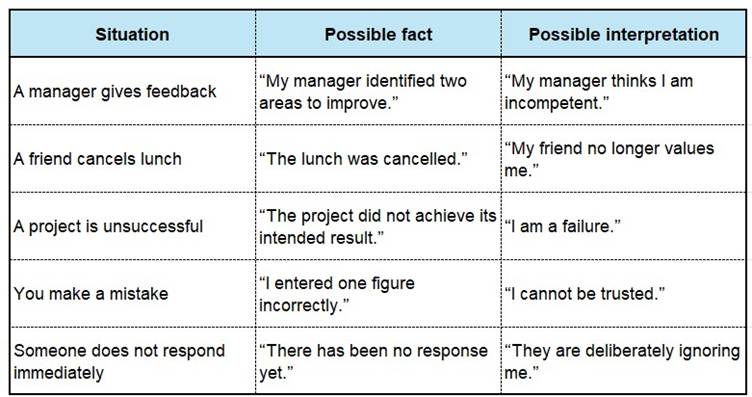
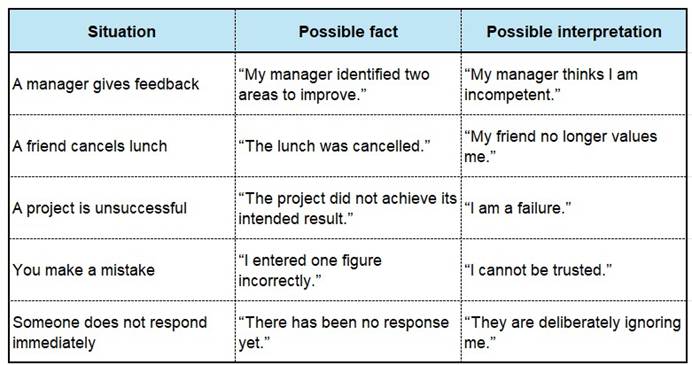
A fact is defined as something that can be directly observed, recorded, or verified by independent sources. For example, if a person does not respond to a message, the fact is simply that there has been no response. On the other hand, an interpretation is the meaning, explanation, or assumption that we apply to that fact. It is our personal perspective or judgment based on the information we have, which may or may not reflect reality.
Consider a scenario depicted in a hypothetical graph. It starts with an individual not responding immediately to a message. The accurate observation here is straightforward: “There has been no response yet.” However, the interpretation might lead to a statement like: “They are deliberately ignoring me.” Although this interpretation is possible, it is essential to recognise that it is not the only explanation for the lack of response. The individual might be preoccupied with other matters, the response could be delayed for legitimate reasons, or external factors might affect communication, such as timing, available resources, or unforeseen circumstances.
When you find yourself interpreting a situation, it can be helpful to rephrase your thoughts in more neutral language. This practice allows for a clearer perspective and reduces the likelihood of negative self-judgment. For example:
- The thought “I am useless” could be reframed as “I am disappointed with how this task went.” This adjustment acknowledges the feeling without being harsh on oneself.
- Instead of saying “Nobody respects me,” you might say, “I felt overlooked in that conversation.” This phrasing highlights the emotion without generalising it to everyone.
- The belief “I will never improve” could be modified to “Improvement has been slower than I hoped.” This way, it recognises the challenge while leaving room for future growth.
- The thought “Everyone is judging me” can become “I am worried that some people may judge me.” This transformation expresses concern without assuming universal judgment.
Revising your thoughts in this manner does not diminish the significance of the problem at hand. Instead, it reduces the unfounded certainty and personal condemnation often associated with negative interpretations. By doing so, it opens up space for a more measured and accurate response, allowing for a better understanding of the situation and potential pathways forward.
Questions for Testing a Belief
When a belief leads to negative thinking or feelings, it’s often more helpful to reframe the question from “How can I force myself to think positively?” to a more constructive approach: “What is the fairest and most accurate way to understand this situation?” This shift encourages a more nuanced and reflective perspective on the belief in question.
Examine the Evidence
Identify Supporting Evidence: Begin by asking yourself, “What specific evidence supports this belief?” This requires you to reflect on tangible instances or data that reinforce your belief. Consider concrete examples or situations that align with what you believe.
Identify Contradictory Evidence: Next, assess the contrary viewpoint by asking, “What evidence does not support this belief?” This step involves contemplating instances or facts that challenge or contradict your belief.
Assess Consistency vs. Anomaly: Consider whether your belief is based on a singular incident or a consistent pattern. Ask yourself, “Am I relying on one incident or a consistent pattern?” A single event can distort your perception if you allow it to define your entire belief.
Expectation of Facts: Reflect on the implications of fully embracing your belief. Ask, “What facts would I expect to see if the belief were completely true?” Conversely, consider a partial truth by inquiring, “What facts would I expect to see if it were only partly true?” This enables you to explore the depth and nuances of your belief.
Specificity Over Vagueness: Ensure that the evidence you are considering is specific rather than vague. Instead of saying, “I always get things wrong,” focus on clear instances like, “I made three mistakes on that task.” Specificity helps ground your beliefs in reality.
Check for Thinking Errors
To dive deeper into your thought process, evaluate whether you’re falling into any common cognitive traps:
Extreme Language: Be wary of absolutes in your language. Are you using words like “always,” “never,” “everyone,” or “no one”? Such terms can exaggerate the situation and distort your perception.
All-or-Nothing Thinking: Ask yourself if you are viewing the situation in black-and-white terms. Are you treating it as all-or-nothing? This perspective can limit your understanding and options.
Predictive Errors: Reflect on any tendencies to predict outcomes as if they were certain. Do you assume you know what the future holds? Such assumptions can lead to unnecessary anxiety.
Mind Reading: Challenge the notion that you can definitively know what another person thinks. Are you assuming their thoughts or feelings? This can skew how you perceive interactions.
Negativity Bias: Consider whether you are focusing exclusively on negative information. Are you overlooking positive aspects of the situation? Balancing your perspective is crucial.
Discounting Positives: Evaluate if you are dismissing positive evidence because it contradicts your belief. Are you allowing a single narrative to overshadow potential good outcomes?
Emotional Reasoning: Be cautious of treating your feelings as proof of validity. Are you judging the situation based solely on your emotions? Feelings can be deceptive and may not reflect reality.
Personal Judgments: Finally, assess whether you are defining your entire character based on a single behaviour. Are you allowing one misstep to cloud your self-perception?
These questions reflect a process known as cognitive restructuring, which aims to identify automatic thoughts, examine the evidence behind those thoughts, and consider alternative explanations.
Consider Other Viewpoints
Explore Alternative Explanations: Challenge yourself to think of at least two alternative explanations for the situation at hand. Expanding your view can illuminate aspects you hadn’t considered.
Compassionate Self-Talk: If a friend were in your situation, what advice or perspective would you offer them? This exercise helps to detach personal emotion from the situation and offers a more balanced perspective.
Fair-Minded Observation: How might an impartial observer describe what happened? This question encourages detachment and helps to highlight objective information versus subjective interpretation.
Future Reflection: Imagine how you would view this event six months from now. This longer-term perspective can shift your immediate emotional response and help you envision a more balanced outcome.
Seek Additional Information: Are there facts or insights that you do not yet have? Acknowledging that your understanding may be incomplete can foster openness to new information.
Dual Realities: Consider whether both the difficulty and your ability to cope can be true at the same time. This duality can broaden your perspective and alleviate pressure.
Test the Belief in Practice
Some beliefs can be challenged through practical experimentation. Engage in small behavioural experiments:
Making Requests: If you hold the belief that “People will reject me if I ask for help,” challenge this belief by making one reasonable request of someone and carefully observing their response.
Practice and Improvement: If you believe “I cannot learn this,” dedicate a limited period to practice the task and track any improvements. This reflects tangible progress rather than perceived limitations.
Managing Mistakes: If you fear that “Any mistake will ruin my reputation,” deliberately make a minor error, correct it promptly, and observe the actual outcome. Often, the aftermath of such mistakes is much less detrimental than fear leads us to believe.
The ultimate purpose of these exercises is not to guarantee success but rather to gather a more substantive and varied evidence base than your initial belief may allow. Engaging in this reflective process can lead to a healthier, more balanced understanding of your beliefs and their implications.
Replacing Rigid Statements: A Path to Balanced Thinking
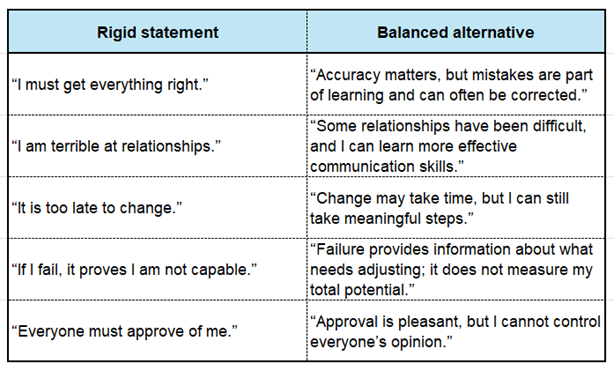
In our journey toward personal development and emotional resilience, it’s essential to replace rigid and often self-defeating statements with balanced, constructive alternatives. When faced with setbacks or disappointments, we may fall into extremes, such as thinking, “I am a complete failure.” However, adopting a more nuanced perspective can significantly improve our mental well-being and motivation. It’s crucial to acknowledge that while overly optimistic statements like “I can achieve anything” may feel uplifting, they can also come across as unrealistic or insincere. A more credible alternative might read, “This outcome was disappointing, but it does not define my overall capabilities or future potential. I can reflect on what went wrong here and determine my next steps.”
There are four core components to effective alternatives that can guide our thinking:
Acknowledge the Difficulty: Start by recognising the challenge at hand. For instance, saying, “This situation is indeed challenging,” validates your feelings and lays the groundwork for constructive thought.
Limit the Conclusion: Avoid broad generalisations; remind yourself, “This setback does not define who I am or my entire set of capabilities.” It’s vital to understand that one event does not encompass your entire potential.
Recognise Existing Evidence: Reflect on experiences where you have successfully navigated difficulties in the past. For example, you might say, “I have faced tough situations before and managed to overcome them.”
Identify a Next Step: Conclude with a practical action you can take that moves you forward, such as, “I can ask for feedback on my proposal and dedicate time to practising the necessary skills for future submissions.”
Examples of Balanced Alternatives
- Instead of thinking, “If I fail, it proves I am not capable,” you might say, “Failure provides valuable information about what needs to be adjusted; it doesn’t measure my entire potential.”
- Changing from “Everyone must approve of me” to “While approval is nice, I recognise that I cannot control everyone’s opinions” empowers you to focus on what truly matters—your self-acceptance.
Balanced thinking is distinct from mere positive thinking. It lets you hold space for uncertainty and limitations while embracing personal responsibility and hope.
Worked Example: Challenging the Thought “I Am Not Good Enough”
To illustrate this process, let’s consider a specific anecdote. Imagine an individual who submits a proposal to present at a professional event but is ultimately not selected. We can break down their thought process as follows:
Identify the Situation: The initial situation is that their proposal was not accepted for the event. At this point, it’s crucial not to add unwarranted conclusions, such as “because I am inadequate.”
Notice the Automatic Thought: The immediate reaction might be, “I am not good enough. People like me never get chosen.”
Identify the Emotional Impact: This thought carries significant emotional weight. The person might feel disappointment at 80 out of 100, shame at 65, and considerable anxiety (70) about future attempts. The intensity of these emotions indicates the event matters to them, but it doesn’t confirm the validity of the original belief.
Separate Facts from Interpretations
Known Facts
- I submitted a proposal.
- The organisers chose not to select it.
- The specific reasons for their decision remain unknown.
- Other proposals were favoured.
Interpretations
- I am not good enough.
- The organisers must have deemed my work poor.
- I will never be chosen for these opportunities.
- There’s no point in applying again, ever.
It’s essential to recognise that multiple factors could affect the decision, such as limited available slots, the event’s overall theme, the timing of submissions, the structure of competing proposals, or even the organisers’ preferences for certain subjects.
Test the Evidence
Evidence Supporting the Belief
- The proposal was not successful.
- I may have received limited positive feedback.
- I felt uncertain during the preparation process.
Evidence Against the Belief
- I had the knowledge and confidence to submit my idea in the first place.
- I have completed relevant work in the past, which speaks to my capabilities.
- One rejection cannot capture the full scope of my abilities.
- The rejection doesn’t provide insight into the complete selection process.
- The proposal could be improved with clearer positioning or more robust examples.
Identify Thinking Errors: The original thought contains several cognitive distortions:
Overgeneralisation: A single unsuccessful application is mistakenly seen as a definitive judgment on all future applications.
Labelling: The experience morphs into a negative identity as the person labels themselves inadequately based on one result.
Mind Reading: The individual presumes to know what the organisers think without any evidence.
All-or-Nothing Thinking: Not being selected is improperly treated as absolute proof of either being entirely good enough or not.
Create a Balanced Alternative: A more balanced thought might read: “Not being selected for this event is disappointing, but it does not prove that I am not good enough. The decision may have been influenced by factors such as the topic, timing, or the level of competition, as well as potential areas where my proposal could improve. I can seek feedback, work on refining my submission, and decide if I want to apply again elsewhere.”
This statement is more credible because it recognises the disappointment while disentangling the outcome from the person’s identity and, most importantly, re-establishing a sense of choice and agency.
Choose a Practical Response: In the face of this new perspective, the individual might take several constructive steps:
- Request succinct feedback from the event organisers to understand their decision.
- Analyse their proposal against those of successful presenters to identify areas for enhancement.
- Focus on improving aspects such as the opening, audience engagement, and supporting evidence in their submission.
- Seek out a trusted colleague’s opinion on the next proposal to gain insights and support.
- Pursue submission opportunities for other suitable events.
- Track applications and outcomes thoughtfully, viewing each experience as part of a larger learning process rather than a final judgment.
While embracing this new way of thinking may not dissolve disappointment immediately, the goal is to diminish the original thought’s control enough to allow for constructive responses that pave the way for growth and future success.
Practising Flexible Thinking
Changing a limiting belief is typically a gradual process rather than a sudden realisation. Many of these old beliefs have been ingrained over years of repetition so that they can resurface automatically, especially in stressful situations. To begin transforming these thoughts, it’s helpful to use a simple tool known as a thought record.
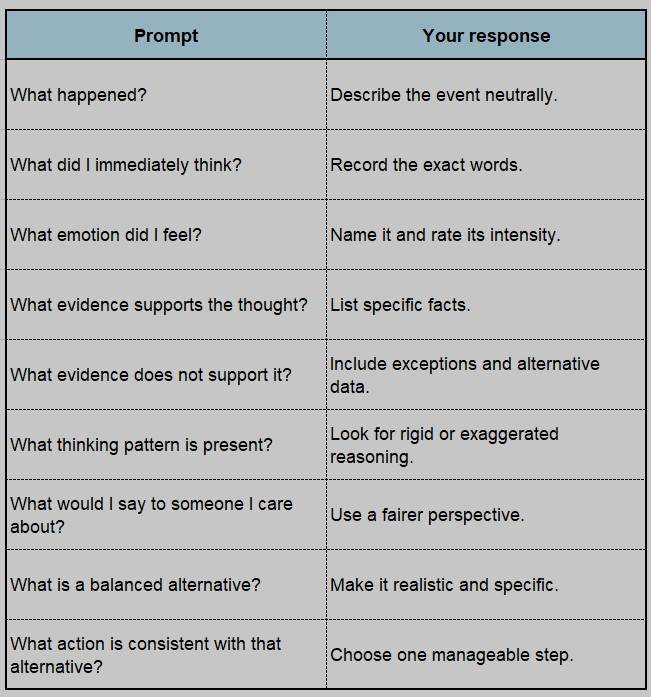
What would I say to someone I care about
Instead of being harsh or critical, take a moment to adopt a more compassionate perspective. If a loved one were experiencing similar thoughts, how would you respond? This can help you access a fairer and kinder internal dialogue.
What is a balanced alternative?
Consider what a balanced and realistic alternative to the negative belief might be. This alternative should be not only positive but also specific and achievable. For instance, instead of thinking, “I am not good enough,” you might reframe it to, “I have skills and strengths, and there are also areas where I can grow.”
What action is consistent with that alternative
Identify one manageable and constructive step you can take that aligns with the new belief. This could be anything from reaching out for support, setting a small goal related to your growth, or simply practising self-care. Focusing on achievable actions can empower you to move forward without feeling overwhelmed.
The goal of this process is not to argue with every negative thought or to suppress difficult emotions. Instead, it’s about creating a mindful pause between an event and the interpretation or conclusion you draw from it. For example, instead of automatically thinking, “I am not good enough,” you can train yourself to acknowledge, “I am experiencing self-doubt right now, and I have the opportunity to examine the evidence before jumping to a conclusion about my abilities.”
If self-critical beliefs are particularly persistent, overwhelming, or linked to deeper issues such as depression, anxiety, trauma, self-harm, or suicidal thoughts, seeking professional guidance is crucial. Cognitive behavioural therapy (CBT) or similar therapeutic approaches can provide structured support to identify and change unhelpful thought patterns. In Australia, individuals can consult with a general practitioner (GP) or a qualified mental health professional to explore suitable support options and resources for their specific needs. This professional support can be instrumental in navigating through challenging emotions and experiences.
