
Practising Active Listening and Building Stronger Relationships: Active listening is an intentional communication skill that goes beyond the passive act of hearing what another person says. It involves deep concentration, understanding, and thoughtful engagement with the speaker’s message. To practice active listening effectively, one must fully immerse themselves in the conversation and demonstrate genuine interest in what the other person is saying.
This skill requires mental and emotional engagement, and the listener must give their undivided attention—minimise distractions, whether from electronic devices or environmental noise—so the speaker feels heard and valued. Active listeners not only hear the words but also observe non-verbal cues such as body language, facial expressions, and tone of voice, which often convey more than the spoken words themselves.
A crucial aspect of active listening is reflecting what you understand. This involves paraphrasing or summarising the speaker’s main points to confirm comprehension. For example, one might say, “So what I’m hearing is that you feel overwhelmed with your current workload, is that right?” This not only shows that the listener is engaged but also provides the speaker an opportunity to clarify or expand on their thoughts.
Additionally, active listening includes asking clarifying questions. These questions deepen understanding and show a commitment to grasping the speaker’s point of view. Questions like, “Can you explain more about that?” or “What do you think caused that situation?” invite further dialogue and encourage the speaker to share more of their thoughts and feelings.
Practising active listening fosters stronger relationships by building trust and reducing misunderstandings. It creates an environment where individuals feel free to express themselves, knowing that their perspectives are valued and respected. When people feel heard and understood, their emotional connection strengthens, laying the groundwork for healthier, more effective communication in personal and professional relationships.
In essence, mastering the art of active listening can profoundly enhance your interactions with others, creating meaningful connections and promoting a culture of understanding and empathy.
Understanding Active Listening in Depth
Active listening is a skill that goes beyond mere auditory processing; it is a conscious, purposeful effort to engage with the speaker on multiple levels. This practice is not only about hearing the words being spoken; it also involves thoroughly understanding the underlying emotions and intentions that accompany them.
To truly practice active listening, one must focus entirely on the speaker and set aside both internal and external distractions. This means creating an environment that is conducive to open conversation, free from interruptions, and allowing oneself to be fully present. Active listeners refrain from jumping to conclusions or forming judgments before the speaker has fully expressed their thoughts, which promotes a more genuine dialogue.
In addition to attentive listening, providing feedback is crucial to this practice. Feedback can take the form of paraphrasing—restating what the speaker has said in your own words—or summarising key points to confirm understanding. This not only reinforces the clarity of the conversation but also demonstrates to the speaker that their input is being taken seriously. By validating their thoughts and feelings, active listeners foster trust and a deeper connection.
Ultimately, active listening is about more than just exchanging information; it is an empathetic engagement that acknowledges the speaker’s experiences and emotions. This deepened understanding paves the way for more meaningful relationships, as it assures the speaker that their perspective is recognised and valued.
The Difference Between Hearing and Listening
Hearing and listening, while often used interchangeably, represent two fundamentally different processes that play crucial roles in communication.
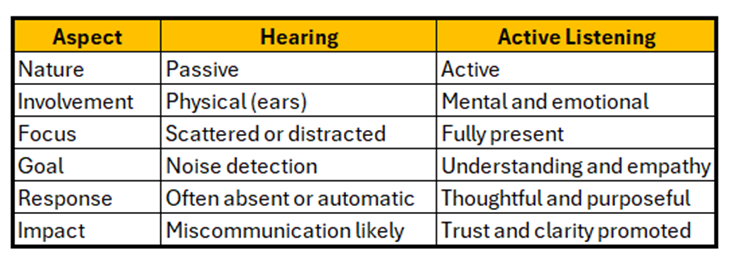
Hearing is a passive and physiological activity that occurs when sound waves travel through the air and are detected by our ears. This process involves the mechanical function of the auditory system, where sound enters the ear, is converted into neural signals, and is sent to the brain for processing. Importantly, hearing can occur without conscious effort or engagement; one might hear background noise while focusing on a task, and it often happens without the intent to comprehend or connect with the sounds being perceived. As a result, this type of auditory reception may lead to misunderstandings or missed information, especially when distractions are present.
In contrast, listening is an active and cognitive process that demands our full attention and engagement. To listen effectively, one must not only hear the spoken words but also interpret their meaning and emotional nuances. This involves a conscious effort to focus on the speaker and consider their perspective, feelings, and the context of the message. Active listening requires mental engagement, where the listener reflects on the information being shared, asks questions, and provides feedback—essentially creating a dialogue built on understanding and empathy.
The goals of active listening are both distinct and significant: while hearing may involve detecting noise, listening seeks to foster a deeper comprehension of the content, develop emotional connections, and promote clarity in communication. Active listening encourages trust between the speaker and listener, greatly reducing the potential for miscommunication and enhancing the overall effectiveness of the conversation.
The following table further illustrates the differences between hearing and active listening:
In summary, while hearing is an involuntary process that occurs without much effort, listening requires intentionality and engagement. Developing one’s listening skills can profoundly enhance personal and professional relationships, leading to more effective communication and a better understanding of the individuals involved.
Common Listening Barriers
Effective listening is often hindered by barriers that impede our ability to engage with and understand the speaker fully. One significant category of barriers is environmental distractions. These include external factors such as background noise from conversations, machinery, or traffic, as well as visual clutter in the surroundings. For instance, a disorganised workspace or a busy café can divert attention away from the speaker. Interruptions, whether from people entering the room or notifications from electronic devices, can also disrupt the flow of communication and make it challenging to concentrate on the message being conveyed.
Another critical aspect is the psychological barriers that listeners might face. These barriers encompass emotional stress, which can cloud judgment and make it difficult to focus on what is being said. Additionally, personal biases—preconceived notions about the speaker or the subject matter—can warp a listener’s understanding. When listeners approach a conversation with assumptions about the speaker’s intentions or values, they may interpret messages through their own perspectives rather than truly grasping the speaker’s point of view. This misinterpretation can lead to misunderstandings and further communication breakdowns.
Moreover, habitual behaviours can significantly diminish listening quality. For example, multitasking—trying to engage with a conversation while simultaneously handling other tasks—can severely undermine the effectiveness of listening. Similarly, interrupting the speaker or planning a response while they are still speaking detracts from truly absorbing their message. These habits not only reduce comprehension but can also make the speaker feel undervalued and unheard, potentially straining the relationship between both parties.
In summary, being aware of these listening barriers—environmental distractions, psychological obstacles, and habitual behaviours—can help individuals improve their listening skills and foster more effective communication.
Utilising Open Questions and Reflective Responses for Effective Communication
Open questions are a valuable technique in conversations that encourage the speaker to delve deeper into their thoughts and feelings. By posing open-ended inquiries, the listener invites the speaker to elaborate, offering a more comprehensive understanding of their perspective. Examples of such questions include: “Can you tell me more about that?” which prompts the speaker to provide additional details, or “What do you think would be the best next step?” which encourages them to reflect on potential actions or solutions. These types of questions demonstrate genuine curiosity and engagement, fostering a more meaningful dialogue.
Reflective responses are another crucial element of effective communication. This technique involves paraphrasing or summarising what the speaker has communicated, which helps to confirm understanding and convey empathy. For instance, if a speaker expresses frustration, a reflective response might be, “It sounds like you’re feeling frustrated because…” This not only validates the speaker’s emotions but also clarifies the message. Alternatively, saying, “So what you’re saying is…” allows the speaker to hear their thoughts echoed back, reinforcing that their feelings and opinions are acknowledged.
Incorporating both open questions and reflective responses in conversations not only enhances clarity but also fosters a safe space for individuals to share their experiences. This approach helps build trust in the communication process and validates the speaker’s feelings, ultimately leading to more productive and empathetic interactions.
Showing Empathy Without Immediately Offering Advice
Empathy in active listening goes beyond simply hearing the words; it involves acknowledging and validating the speaker’s emotions. When someone shares their struggles or feelings, resist the urge to rush in with solutions or advice. Instead, focus on conveying understanding and compassion.
For instance, you might respond with statements like, “That sounds really challenging,” or “I can see why you’d feel that way.” These phrases affirm the speaker’s experience, showing that you are not only listening but also genuinely invested in their emotional well-being.
This empathetic approach allows the speaker to feel truly heard and supported in their moment of vulnerability. By fostering an environment where they can express themselves freely, you help them process their feelings more effectively. Often, this reflection enables them to arrive at their own insights and potential solutions, empowering them to take ownership of their situation.
Moreover, offering empathy without immediately offering advice builds trust and reinforces the emotional connection between you and the speaker. This can enhance their willingness to share more openly in the future, knowing that their feelings are valued and respected. Ultimately, the goal is to create a safe space where emotions can be explored and understood, paving the way for personal growth and resolution.
Examples for Partners, Family Members, and Workplace Relationships
Partners: When your partner expresses frustration about their job or workplace challenges, offer a thoughtful, empathetic response. Rather than jumping in with immediate solutions or advice—which can sometimes feel dismissive—you might say something like, “It sounds like you’re feeling really overwhelmed by everything at work right now. I can see this is weighing heavily on you. Can you share more about what’s been happening?” This approach not only validates their feelings but also encourages them to delve deeper into the conversation. It shows that you’re genuinely interested in understanding their experiences and emotions.
Family Members: In family dynamics, emotions can run high, especially when difficult decisions are being discussed. If a family member expresses distress about a particular choice or upcoming change, a supportive response could be, “I can hear that you’re really worried about this situation. What’s the biggest concern that’s on your mind?” This response demonstrates empathy by acknowledging their feelings and provides them with space to elaborate on their thoughts. It invites a deeper dialogue, allowing them to express their worries and feel heard in the process.
Workplace Relationships: During team meetings, it’s crucial to foster an environment where everyone feels comfortable expressing their concerns. If a colleague raises a specific issue, such as a bottleneck in workflow, you might respond with, “So you’re saying that the current process is causing delays, which is impacting our productivity. That sounds frustrating. What do you think would help improve this situation?” By validating their concern and encouraging them to suggest solutions, you demonstrate active listening and promote a culture of collaborative problem-solving. This not only builds rapport but also empowers team members to contribute their ideas for improvement.
A Comprehensive Active-Listening Exercise for Readers
Active listening is a valuable skill that promotes understanding and connection in conversations. Here’s a detailed exercise you can try with a friend or colleague to enhance your active listening abilities:
1. Pair Up:
Start by finding a partner—this could be a friend, colleague, or anyone you feel comfortable sharing thoughts with. Decide on a comfortable and quiet space to minimise distractions. One person will take the role of the speaker while the other will be the listener.
2. Speaking Time:
The speaker will express their thoughts on a chosen topic that holds significance for them, such as a recent challenge they faced, a personal goal they are striving towards, or an experience that has influenced them. They will speak uninterrupted for two minutes. During this Time, the listener should focus intently on the speaker’s words, body language, and emotional tone, avoiding any distractions or preparations for their own remarks.
3. Reflecting:
Once the speaker has finished their two-minute monologue, the listener will take a moment to gather their thoughts before paraphrasing what they understand. They might use phrases such as, “What I’m hearing is that you’re feeling…” or “It seems like you believe that…”. This reflection helps the speaker feel heard and encourages them to clarify any points if necessary.
Clarifying:
After the reflection, the listener should ask an open-ended question to delve deeper into the topic. This question should invite the speaker to share more details or expand on their experiences. For example, the listener might ask, “Can you tell me more about what led you to that decision?” or “What was the most challenging aspect of that situation?” This step is crucial as it encourages exploration of feelings and thoughts in a safe environment.
5. Switch Roles:
After the first round, take turns. The listener now becomes the speaker, discussing their own topic of significance and following the same process as outlined above.
By following this exercise, both participants will practice focusing fully on the speaker, honing their ability to reflect the message effectively, and asking meaningful follow-up questions. These components are fundamental to mastering the art of active listening.
Integration into Daily Conversations
To reap the full benefits of active listening, strive to incorporate these techniques into your daily interactions, whether in personal relationships or professional settings. Improved active listening can lead to stronger, more empathetic relationships, fostering a greater sense of connection and understanding in all areas of life.
