
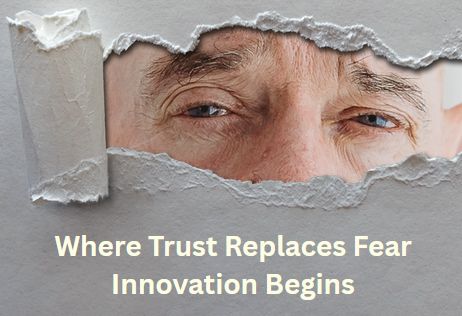
Where Trust Replaces Fear Innovation Begins-True progress truly begins when individuals break free from the constraints of fear, allowing trust to take root in its place. This transformative shift occurs when people feel valued not merely for their ability to achieve flawless results but for their commitment to trying, thinking critically, and growing as individuals. In such an environment, a well-analysed mistake is viewed as a stepping stone to advancement rather than a hindrance. Here, the essence of courage thrives—new ideas begin to sprout, voices become more assured, and potential grows exponentially. Innovation is not merely a goal to be chased; it emerges organically when individuals are given the freedom to explore, learn, and push past conventional boundaries.
To create a setting where taking informed, calculated risks is not just accepted but encouraged, the foundation must be built on trust. Individuals need to believe that their worth is not exclusively tied to achieving perfect results but also to their thoughtful efforts and proactive initiatives. When team members are confident that making a well-considered mistake will not tarnish their reputation or diminish their standing, they become much more inclined to venture beyond their comfort zones. This sense of psychological safety becomes the cornerstone for fostering innovation, enabling ideas that might otherwise have remained unspoken to surface.
At the heart of making smart risk-taking a safe practice is a profound reexamination of how failure is perceived within the organisation. Rather than viewing mistakes as setbacks that hinder progress, we should regard them as crucial data points—valuable, educational, and fundamentally necessary for growth. When leaders and team members consistently frame errors as opportunities for learning and development, they convey an important message: progress is far more significant than perfection. This transformative shift diminishes fear and replaces it with a spirit of curiosity, prompting individuals to ask constructive questions such as “What valuable lessons can we extract from this experience?” rather than assigning blame with questions like “Who is responsible for this failure?”
Promoting a culture of experimentation is a practical and effective way to imbue this growth-oriented mindset into the fabric of daily work life. Implementing small tests, pilot programs, and low-stakes trials allows individuals to test new ideas without the weight of dire consequences hovering over them. These controlled environments function as a safety net, within which failures can be contained and valuable insights maximised and analysed. Over time, this method cultivates self-assurance, as individuals witness firsthand that taking initiative leads to opportunities for growth rather than punitive repercussions.
The concept of “failing forward” is pivotal in this narrative. It emphasises the idea of momentum, asserting that each misstep is not a conclusion but rather a vital stepping stone toward essential refinement and continuous improvement. When teams are trained to reflect on their experiences—analysing what strategies were effective, what fell short, and understanding the underlying reasons—they cultivate robust problem-solving skills and resilience in the face of challenges. This iterative approach ensures that even less-than-successful attempts contribute meaningfully to future successes.
It is crucial to note that creating a safe environment for risk-taking does not equate to endorsing reckless behaviour. The vital distinction lies in the notion of intentionality. Smart risk-taking entails a methodical approach that encompasses careful consideration, clearly defined objectives, and a thorough understanding of potential outcomes. It demands that individuals weigh their options thoughtfully, contemplate their impacts, and proceed with a sense of awareness rather than impulsiveness. By maintaining this delicate balance, organisations can effectively nurture creativity while simultaneously safeguarding stability and protecting vital resources.
Leadership plays a pivotal role in nurturing and reinforcing a culture that embraces smart risk-taking within an organisation. When leaders take the courageous step of openly sharing their mistakes and the valuable lessons they have gleaned from them, they create an environment where imperfection is normalised. This kind of transparency serves a dual purpose: it not only reduces the stigma often associated with failure but also powerfully illustrates that personal and professional growth is an ongoing process that occurs at every level of the organisation. Moreover, such openness builds trust and credibility; employees are more inclined to take measured risks when they witness that vulnerability is not only accepted but esteemed within their leadership.
Integral to fostering this culture are robust feedback systems that support safe risk-taking. Constructive, timely, and specific feedback is essential as it helps individuals grasp the impact of their actions without the paralysing fear of judgment. When feedback is directed toward behaviours and outcomes rather than personal attributes, it reinforces the concept that mistakes are integral to the learning and developmental process. This approach encourages individuals to remain engaged and motivated, empowering them to experiment and innovate without the anxiety of harsh criticism.
Over time, a culture that genuinely embraces smart risk-taking becomes self-sustaining. Individuals gradually take ownership of their learning, becoming more proactive in identifying opportunities to test new ideas and make improvements. Collaboration flourishes in this environment; team members feel more at ease sharing early-stage concepts and building on each other’s insights. The cumulative effect is a dynamic and lively atmosphere where innovation can flourish organically; creativity thrives, driven by a collective sense of exploration and shared success.
The ultimate goal in cultivating this environment is to create a space where calculated risk-taking is not just tolerated but anticipated. By establishing clear boundaries and guidelines while allowing freedom to explore and experiment, organisations can empower individuals to think creatively, while remaining grounded in a sense of responsibility and accountability. This delicate balance ensures that risk is viewed not as a source of trepidation but as a valuable tool for progress and advancement.
In such a constructive environment, growth becomes both a continuous and a collective endeavour. Every experiment, whether it leads to success or failure, contributes to a broader understanding that benefits the team and the organisation as a whole. Over time, this gradual accumulation of knowledge and insight translates into better decision-making, stronger outcomes, and ultimately, a more confident and capable team. Making smart risk-taking safe is not merely a strategy—it evolves into a transformative mindset that reshapes how individuals approach challenges, seize opportunities, and realise their full potential.
