
Should Managers Be Friends With Their Teams? Managers can—and often should—be friendly with their teams; however, becoming genuine friends with direct reports can create conflicts between personal closeness and professional responsibilities. The healthiest approach is to maintain a warm and trusting rapport without showing favouritism. Managers can get to know their team members, care about their wellbeing, and build strong relationships while still upholding standards, making difficult decisions, and ensuring fairness.
The Benefits Of Manager-Team Rapport
A manager who understands their team can cultivate a workplace that is both supportive and highly productive. Establishing a friendly rapport among team members creates an environment where employees feel comfortable raising concerns early, seeking assistance when needed, sharing innovative ideas, and embracing constructive feedback without fear of personal criticism. Numerous studies and workplace discussions have consistently highlighted a strong correlation between strong workplace relationships and higher levels of employee engagement, overall wellbeing, and performance.
Furthermore, cultivating rapport enables managers to lead with a clear sense of context. When a manager takes the time to understand their team members’ individual strengths, career aspirations, preferred working styles, and personal challenges—while maintaining appropriate boundaries—they are better positioned to delegate tasks more thoughtfully. This understanding enables more effective coaching, as managers can tailor guidance to each employee’s unique needs and goals. Additionally, recognising contributions in ways that resonate personally with team members fosters a sense of appreciation and value. Employees who trust their leaders are typically more receptive to feedback and show greater resilience when facing challenging work scenarios.
Crucially, friendliness does not require managers to divulge every detail of their private lives or develop an emotionally dependent relationship with their team. Instead, a manager can be approachable, show empathy, and maintain a human connection while still upholding the clarity and authority their leadership role demands. By striking this balance, managers can create a positive organisational culture that promotes collaboration and excellence.
The Risks of Friendship at Work
The fundamental concern lies not in managers’ inherent kindness, but in how personal connections can obscure their judgment, distort communication, and skew perceptions of fairness. Managers are tasked with a variety of critical responsibilities, including evaluating employee performance, allocating growth opportunities, managing conflicts within their teams, and occasionally making decisions that may not be popular with their staff. When a manager develops friendships with their subordinates, the emotional weight of these responsibilities can become significantly more complicated. This close relationship can lead colleagues to question whether decisions are genuinely based on merit or if favouritism is at play.
This issue is particularly pronounced because of the formal authority managers hold within an organisation. Even if a manager sincerely believes they are treating a close friend the same as all other employees, their team’s perceptions may differ greatly. Colleagues might interpret extra time spent with a friend, informal communication channels, leniency in performance evaluations, or participation in social activities as signs of bias. Such perceptions of unfairness can harm team morale and cohesion, even when the manager’s actions are well-intentioned and free of actual bias. The nuance of these dynamics highlights the delicate balance managers must maintain to foster a fair and productive work environment.
Favouritism And Perceived Unfairness
Favouritism in the workplace can manifest in various subtle yet impactful ways that may not be immediately apparent. For instance, a manager might subconsciously assign the most prestigious or high-visibility projects to a close friend, thereby giving them an advantage over other team members. Additionally, they might overlook this friend’s repeated tardiness while holding others to stricter punctuality standards. Confidential information can also be shared, where a favoured employee receives insights or advice that others do not, which could unfairly benefit their standing in the workplace.
Moreover, a manager may provide disproportionate coaching or mentoring time to one individual, thereby enhancing that person’s development and visibility within the organisation compared to their peers. This can also extend to advocacy during promotion considerations, where a manager champions an individual’s advancement more vigorously than others, again skewing the fairness of the process. While these actions might stem from good intentions—such as wanting to support a friend—they can ultimately create a toxic environment where other employees feel undervalued and believe personal connections outweigh hard work and measurable achievements.
The perception of favouritism can be just as damaging as its reality. A team does not need hard evidence of misconduct for morale to decline; inconsistent treatment, unclear decision-making processes, or visible social connections among certain team members can foster suspicion and discomfort. These feelings can erode trust within the group, leading to disengagement and resentment.
To mitigate these issues, managers should implement transparent and consistent criteria for performance evaluations, promotion pathways, compensation decisions, project assignments, and professional development opportunities. This ensures that all employees are evaluated based on their achievements and contributions, cultivating an atmosphere of fairness and equity that reinforces the organisation’s overall health. By promoting transparency and accountability, managers can foster a culture where all employees feel valued and motivated, regardless of personal relationships.
Difficulty Giving Hard Feedback
Friendship in the workplace can often complicate the delivery of candid feedback, making it a delicate balancing act for managers. When a manager is close to their team members, they may feel inclined to soften their criticism or postpone difficult conversations about performance issues. This reluctance typically stems from a desire to protect employees’ emotional well-being and maintain positive relationships. However, while this approach may feel compassionate in the short term, it can have detrimental effects in the long run, impacting not only the individual employee’s growth but also the team’s overall efficiency and the organisation’s performance.
The consequence of this avoidance is that employees may remain unaware of their shortcomings, hindering their professional development and negatively affecting team dynamics. Additionally, such indecision can lead to a toxic culture where underperformance is tolerated, and accountability is lacking, ultimately compromising the organisation’s success.
Moreover, the blending of personal rapport with professional responsibilities can create ambiguity about the true purpose of conversations between managers and their team members. Employees may be left wondering whether their manager is speaking from a position of friendship to provide support, or from a supervisory role focused on setting clear expectations and holding them accountable. This lack of clarity can result in misunderstandings and confusion, which are counterproductive to both individual and organisational goals.
To mitigate these issues, Harvard Business Review advises managers to distinguish between these two roles clearly during conversations. For instance, managers might signal the shift by explicitly stating, “This is a work topic that I need to address,” which can help establish a more formal context for the discussion. By doing so, managers create a framework that allows for constructive feedback while preserving professional boundaries, ensuring employees understand the dual roles of support and accountability expected of their leaders.
Blurred Professional Boundaries
Close workplace friendships can significantly complicate boundaries around personal confidences, social media interactions, after-hours communication, and sharing personal problems. When a manager develops a close relationship with an employee, they may inadvertently learn sensitive information that they cannot ethically use when making decisions about workload distribution, promotions, disciplinary actions, or overall team dynamics. For instance, if a manager learns about an employee’s personal struggles or aspirations, these insights could unintentionally impact professional judgments, even if the manager strives to remain impartial.
On the flip side, employees may feel pressured to divulge more personal information than they would normally share, simply because their manager also acts as a friend. This dynamic can create discomfort and anxiety, as the employee may fear that their personal disclosures could influence their professional standing.
In the digital age, maintaining boundaries becomes even more crucial because of the pervasive use of social media. Employees often hesitate to connect with their managers on platforms like Facebook or LinkedIn, recognising that such connections can have broader implications for their careers. This “boundary blurring” phenomenon poses a legitimate challenge for both managers and employees, as it can lead to misunderstandings and discomfort in professional settings.
To navigate these complexities, a straightforward yet effective guideline is to refrain from sharing privately with a work friend any information you wouldn’t be comfortable discussing openly in the workplace. By following this principle, both managers and employees can protect their professional relationships while fostering a supportive, respectful work environment.
Friendly Versus Friends: The Key Distinction
It’s important to distinguish between being friendly and being friends. A friendly manager is approachable, respectful, curious, and supportive. In contrast, a friendship involves deeper personal connections, mutual sharing of confidences, social obligations, and expectations of loyalty, which can sometimes conflict with managerial responsibilities.
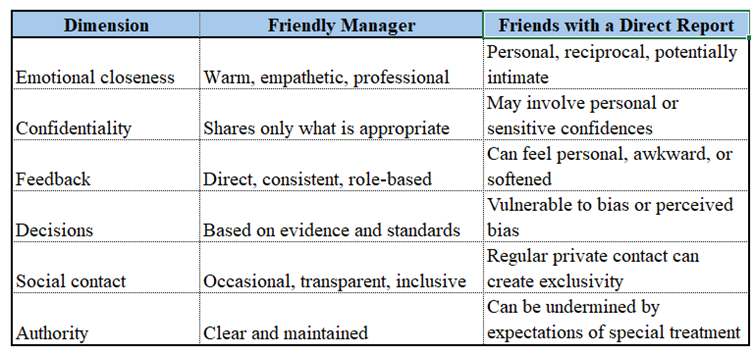
This does not imply that managers need to be cold or distant. Rather, they should be intentional: they can foster trust through consistency, active listening, acknowledgment, and fairness, rather than relying on personal familiarity or exclusive access.
How To Build Trust Without Compromising Authority
Trust within a team is primarily established through consistency and predictability in a manager’s actions and decisions. Managers can cultivate trust by consistently following through on commitments, applying standards uniformly, explaining decisions clearly, maintaining confidentiality in sensitive matters, and treating all employees with dignity and respect, even when they must communicate difficult or unwelcome news.
To foster meaningful connections among team members, managers should implement structured and inclusive practices instead of relying solely on personal friendships or informal interactions. This can be achieved through several key strategies:
Regular One-on-One Conversations: Managers should schedule consistent one-on-one meetings with each team member, ensuring that every individual, regardless of natural rapport, feels valued and heard. These meetings should be a regular occurrence to build a strong foundation for open communication.
Discussing Career Goals and Wellbeing: During these conversations, managers should discuss career aspirations, development needs, workload concerns, and overall wellbeing. This should be approached professionally, signalling genuine interest in the individual’s growth and health.
Recognising Good Work Publicly: Publicly acknowledging outstanding performance can significantly boost morale and motivate the team. This recognition should be specific and timely to reinforce positive behaviour. Conversely, if corrective feedback is necessary, it should always be delivered privately, promptly, and with specific, constructive guidance.
Uniform Performance Criteria: Applying the same performance standards and decision-making processes for all employees underscores fairness and equality. This consistency helps eliminate perceptions of favouritism and ensures everyone is held to the same expectations.
Transparency in Communication: Managers should be transparent about what information can be shared and the rationale behind any limitations. This openness helps build trust as employees understand the reasons behind certain decisions and guidelines.
Optional and Inclusive Social Activities: Social events should be organised with inclusivity in mind, participation should be voluntary, and they should not carry implicit career implications. This approach lets employees engage on their terms rather than feel pressured to join for career advancement.
By adopting these practices, managers demonstrate genuine care for their team members without singling anyone out for preferential treatment. This creates an environment where expectations are clear, making it easier for managers to hold everyone accountable while maintaining a respectful, trustworthy team dynamic.
Practical Boundaries For Managers
Managers should proactively establish clear boundaries at the start of their reporting relationships, particularly when a friendship with the employee existed before the managerial role. Engaging in a direct, candid conversation about the relationship dynamics can help avert possible feelings of resentment or unfairness later on. The manager should communicate that they genuinely value the friendship but also emphasise the importance of maintaining professionalism. They must clarify that they cannot offer preferential treatment, share confidential information, or compromise on delivering honest performance feedback.
Several practical boundaries can be established to ensure that the relationship remains both friendly and professional:
Separate Work and Personal Time: It’s essential to delineate between personal interactions and work-related discussions. Avoid bringing up performance evaluations, salary negotiations, promotions, or sensitive information about others during social events, casual messages, or private conversations. This separation helps maintain a professional atmosphere and prevents misunderstandings.
Label the Conversation: When discussing matters with a friend who is also a direct report, clarify whether you are speaking in your capacity as a manager or as a friend. Clearly indicating your stance helps both parties interpret the context correctly, thus minimising potential miscommunications.
Use Objective Standards for Evaluation: Performance evaluations and opportunities for advancement should be anchored in established and documented criteria. Tying assessments to specific goals, observable behaviours, and tangible results rather than personal feelings or affinities ensures fairness and transparency in the process.
Avoid Exclusive Access: Managers should be vigilant about not giving one individual more informal engagement, insider knowledge, or decision-making influence than others on the team. Equal access and communication promote equity and reduce perceptions of favouritism.
Be Cautious Online: Exercise discretion when connecting with direct reports on personal social media platforms. Posts shared in these spaces might expose private information or create the perception of an inappropriate closeness that could compromise a manager’s authority and objectivity.
Escalate Potential Conflicts of Interest: When a personal friendship could influence decisions about hiring, promotions, disciplinary measures, or compensation, involve Human Resources or another impartial decision-maker. This step safeguards fairness and upholds transparency within the organisation.
Ultimately, effective managers do not have to compromise their humane qualities to be effective leaders. The best leaders strike a delicate balance; they are approachable and friendly enough to foster trust while remaining disciplined, fair, and accountable when the situation calls for it. This duality is essential in cultivating a productive work environment that respects both personal relationships and professional integrity.
Tomorrow: Why “Fail Fast” Leadership Often Fails
- What “fail fast” was meant to solve
- Where the idea breaks down
- Repeated preventable mistakes
- Risk without guardrails
- Learning that never becomes action
- The difference between smart failure and careless failure
- How to experiment responsibly
- A practical framework for learning from setbacks
#Leadership #LearningAndDevelopment #PerformanceManagement
