
Delegation Without Abdication: How to Assign Work and Still Stay Accountable. Delegation without abdication is the nuanced practice of empowering team members with significant ownership of tasks while ensuring the leader remains accountable for the results. Contrary to a common misconception, effective delegation doesn’t mean a leader can assign a task and then step back entirely. Instead, leaders must engage actively by creating the right conditions for success, setting clear decision-making boundaries, providing necessary support, and remaining ultimately responsible for the outcomes of the tasks they delegate. This practice fosters a culture of capability, trust, and high performance, preventing delegation from becoming a way to shirk responsibility.

Begin with the Right Match
Effective delegation commences long before any task is assigned. Leaders must carefully match the work to the individual’s capabilities, development goals, current workload, and the level of judgment the task demands. For instance, assigning a complex, high-stakes project to a team member who lacks essential experience or skills can cause significant frustration and setbacks for both the individual and the team. Similarly, assigning mundane or routine tasks to someone ready and capable of more challenging responsibilities can lead to disillusionment and disengagement.
It’s important to recognise that capability does not equate to perfection. Rather, it means the individual possesses, or can reasonably develop with appropriate guidance, the skills, knowledge, and resources needed to complete the task effectively. Leaders should evaluate whether the person has the technical abilities, contextual awareness, established relationships, and confidence required to undertake a given project. If the answer is “not yet,” that does not automatically disqualify delegation; however, it requires proactive planning, including coaching, access to resources, and closer support during the task’s initial phases.
Considering Development Goals
Development goals play a critical role in delegation, as delegation can be one of the most effective ways to support team members’ professional growth. A staff member may be fully capable of carrying out specific tasks. Still, they might benefit more from assignments that stretch their strategic thinking, stakeholder management, problem-solving, or leadership competencies. When assigned work aligns with an individual’s career aspirations and developmental objectives, it becomes more than a duty; it becomes an investment in their future career trajectory.
Assessing Workload Realistically
Another key consideration in delegation is ensuring the workload is realistic. Delegation should not merely transfer pressure from the leader to an already overburdened team member. Before assigning new work, leaders should thoroughly review existing priorities, deadlines, and their team members’ overall capacity. If a team member is already stretched thin, the leader should take one of several actions: remove or reprioritise existing tasks, extend timelines for current projects, allocate additional resources, or assign the task to someone else. Ignoring workload and existing pressures not only leads to burnout and resentment but also undermines outcome quality.
Evaluating the Level of Judgment Required
Finally, assess the level of judgment each task requires. Some assignments are straightforward and well-defined, while others involve significant ambiguity, conflicting interests, financial risks, reputational implications, or decisions that could affect a broader group of stakeholders. As a task’s complexity and required judgment increase, so does the need for leaders to ensure the individual responsible fully understands the context in which they operate, has access to pertinent information, and knows when to seek guidance. By matching tasks not merely to job titles, but to the required level of judgment and decision-making capacity, leaders can protect both the individual and the organisation from potential pitfalls, fostering a safer, more effective delegation environment.
Define Success Before Handover
Many delegated tasks encounter difficulties and ultimately fail, not because the team member lacks skill or capability, but because expectations were unclear and poorly communicated. For this reason, a leader must clearly define expected outcomes, deadlines, constraints, budget limits, and overall success metrics before assigning any responsibility. This clarity provides a strong, stable framework for the team member, empowering them to take initiative and make informed decisions throughout the process.
Start with the Outcome
When defining the task, start with the desired outcome. Articulate precisely what needs to be achieved, why it holds significance, and how it aligns with the broader goals of the team or organisation. For instance, instead of instructing someone to “Prepare a report,” a more effective approach would be to say, “Prepare a concise customer-feedback report that clearly identifies the three most critical service issues impacting our clients and recommends actionable steps we should take in the upcoming quarter.” The key distinction here is that the first instruction centres around the activity to be performed, while the second emphasises the value and purpose behind the task.
Set a Realistic Deadline
Set a specific, achievable deadline for the task. Phrases like “As soon as possible” lack precision and do not motivate timely action. Instead, a clear deadline such as “Please draft the report by Thursday, and submit the final version by the following Tuesday” gives the team member a distinct timeframe to plan their work effectively. When feasible, agree on interim milestones to support progress reviews without requiring the leader to supervise every step of the project.
Identify Constraints Early
Identifying constraints early is vital to successful execution. Constraints may include, but are not limited to, budget limits, confidentiality requirements, adherence to brand guidelines, legal compliance, established approval processes, technological limitations, or expectations from non-negotiable stakeholders. Understanding these constraints does not limit the team member’s ownership of the task; rather, it sharpens their decision-making by clearly defining the parameters within which they can operate effectively.
Clarify the Budget and Available Resources
Team members need a clear understanding of the budget and available resources. This knowledge will significantly improve their ability to make responsible, informed decisions. For example, if a team member is tasked with organising an event, conducting research, or resolving a customer issue, they need to know whether they have access to $500, $5,000, or no budget at all. Without this clarity, they may struggle to make prudent choices that align with both the project’s goals and the organisation’s financial constraints.
Define Success in Observable Terms
Finally, clearly define success in measurable terms. Leaders should ask: What specific changes will be evident once the work is completed? What standards of quality will apply to the final output? Who needs to be satisfied with the results? What tangible evidence will demonstrate that the desired outcome has been achieved? When success criteria are clear and easy to understand, team members can navigate their responsibilities with confidence and autonomy. Likewise, it enables leaders to assess progress and evaluate outcomes fairly and objectively.
By implementing these guidelines, leaders can create an environment that fosters accountability, encourages initiative, and ultimately drives successful task completion.
Agree on Decision Rights
Effective delegation is essential to team success but can become confusing when the leader and team members assume different decision-making authority. To prevent misunderstandings and ensure clarity, explicitly define and agree on decision rights before the work begins. A useful framework for categorising these rights includes three distinct levels: recommending, deciding with approval, and deciding independently. Each level serves a different purpose and applies in specific circumstances.
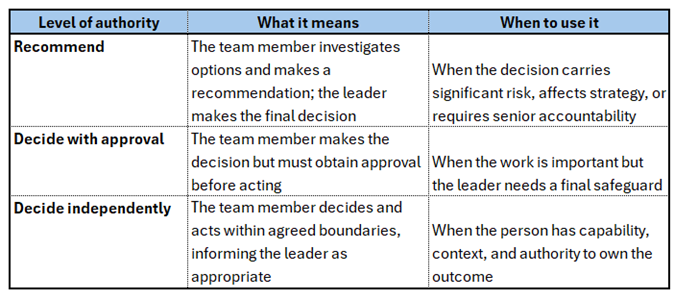
The “Recommend” level matters most when the stakes are high, or the decision requires insights beyond the team member’s immediate expertise. In this scenario, the individual is tasked with gathering relevant information, analysing options, weighing trade-offs, and presenting a well-structured case to the leader. This process not only develops their analytical skills and judgment but also prepares them for greater responsibility in future decisions. However, leaders should use this level judiciously and not rely on it to control every minor detail, as it can stifle initiative and creativity within the team.
The “Decide with approval” level offers a balanced approach that encourages empowerment while still allowing the leader to provide oversight. This level is especially beneficial for team members who are stepping into new roles and responsibilities where they may lack experience. In this structure, the team member is given the space to think critically and prepare their recommendations, but the leader remains involved at the crucial point of commitment or implementation. This ensures that, while the team member feels empowered, the leader can provide essential guidance and input before final decisions are made.
The “Decide independently” level represents the highest delegation authority and communicates trust in the team member’s judgment within established parameters. This level is suitable when the task aligns with the team member’s skills, the associated risks are manageable, and when clear limits and expectations have been set by the leader. Independent authority must include explicit escalation points; the team member should clearly understand which issues—and under what circumstances—require immediate discussion. Key areas may include legal risks, safety concerns, significant budget changes, or actions that could affect the organisation’s reputation.
Ambiguity concerning decision-making authority can lead to detrimental outcomes. Team members may become hesitant, overly dependent on the leader’s input for every minor decision, or, conversely, overreach and make decisions the leader would have preferred to influence. By clearly defining decision rights at the outset, leaders and team members can avoid these issues, paving the way for greater efficiency and workplace satisfaction.
Check In Without Hovering
Once work is delegated, the leader’s role shifts from direct oversight to supportive guidance. Scheduled check-ins become essential opportunities to review progress, remove obstacles, offer targeted assistance, and reinforce the team’s priorities. When done well, these check-ins provide valuable support without slipping into micromanagement, allowing team members to flourish.
A well-structured check-in should focus on four key questions to drive productive conversation:
- What progress has been made? This question allows team members to reflect on their achievements and share how they are advancing toward set objectives.
- What obstacles have emerged? It gives team members a platform to voice challenges, helping leaders identify potential roadblocks and facilitate solutions.
- What support or decisions are needed? This encourages active dialogue about available resources and support from the leader, ensuring team members feel supported.
- What has been learned so far? This helps encapsulate the learning process, allowing for reflection on experiences and gradual improvement over time.
These questions shift the conversation away from scrutinising every action and instead focus on the outcomes and problem-solving needed to move forward effectively.
The frequency of check-ins should match the work’s complexity and risk. For new or high-stakes projects, more frequent conversations—potentially weekly or bi-weekly—may be necessary. As the team member gains confidence and demonstrates capability, the leader can thoughtfully reduce the frequency of check-ins. The aim is not to establish a rigid system of constant oversight, but to strike a balance that provides timely, appropriate support when it is genuinely needed.
Leaders should resist the temptation to check in impulsively whenever anxiety creeps in. Frequent, unscheduled communications, repeated requests for updates, or abrupt changes to agreed methods can inadvertently signal distrust and undermine the delegation process. If the leader feels compelled to intervene, they should first reflect on whether their concerns stem from a legitimate risk, a shift in circumstances, or simply discomfort with relinquishing control.
Additionally, check-ins should function as a two-way conversation. Team members must feel safe and secure expressing their challenges—saying things like, “I am stuck,” “I need more information,” or “I think the original approach is no longer working.” A leader who approaches these disclosures with curiosity rather than criticism fosters psychological safety, encouraging team members to voice concerns early and seek support proactively.
A practical guideline for effective check-ins is to set the schedule at the start of a project, stick to it consistently, and use check-ins to support progress rather than reclaim ownership. If a leader frequently takes control of tasks during these check-ins, it shows they haven’t genuinely delegated the work; instead, they may have added a series of meetings to the original task without fostering true empowerment. By maintaining this balance, leaders can cultivate a motivated, capable team that feels confident in its decision-making.
Make Room for Learning
In any growth-focused environment, create space for individuals to learn from their experiences, including reasonable mistakes. Effective leadership recognises that nobody can truly progress without the chance to stumble and learn from those stumbles. When leaders enforce a culture of perfectionism, they may achieve immediate compliance from their team; however, this approach often stifles initiative, hinders creativity, and limits honest communication among team members. Therefore, leaders should embrace delegation without abdication and foster an environment where teams can have constructive discussions about errors.
Not every mistake is created equal, and leaders must exercise discernment in how they respond to errors. Distinguish between careless or reckless behaviour and well-intentioned mistakes that arise from learning, experimentation, or decisions made with incomplete information. When encountering the first type, leaders should hold individuals accountable and take necessary corrective action. However, when faced with the latter, leaders should provide coaching, reflection, and support, fostering an atmosphere that encourages growth rather than fear of retribution.
When a mistake occurs within a team or organisation, analyse the facts rather than assign blame. A productive discussion should focus on the specifics of the incident: What exactly happened? What did the team member involved expect? What information did they have available? What alternatives did they consider? It’s also helpful to discuss what they would do differently if a similar situation arises in the future. By framing an error as a learning opportunity, leaders can transform a potential setback into a valuable dialogue that nurtures trust and confidence among team members.
Additionally, leaders must also reflect critically on their own roles in these situations. Did they provide sufficient context for the task? Were their expectations clearly articulated? Was the completion timeline realistic? Did the individual have the authority, resources, and support to complete the assignment successfully? In many cases, a delegated task’s failure can be traced to an incomplete handover rather than an inherent incapacity in the team member.
Constructive feedback is an indispensable tool for growth and should be delivered in a timely, specific, and future-focused manner. Instead of simply indicating a mistake with a statement like, “You got this wrong,” leaders can offer a more nuanced critique. For instance, they might say, “Your analysis was solid, but the recommendation did not consider the customer-impact data. In future analyses, let’s ensure that our recommendations encompass both operational viability and customer effects.” This type of feedback preserves the individual’s dignity while improving overall performance.
Embracing the possibility of reasonable mistakes does not equate to abandoning standards or expectations. Instead, it means recognising that mistakes serve as indicators—they provide valuable feedback on the team’s processes, highlight areas for personal development, and reflect the quality of support being provided. Teams learn more effectively when they can identify problems early, discuss them openly, and apply lessons to future work. By building this environment, leaders not only improve their teams’ overall effectiveness but also foster a culture of continuous improvement and resilience.
Retain Accountability, Grant Ownership: The Key to Effective Delegation
Effective delegation without abdication rests on a crucial balance: the leader remains accountable for the overall outcome while empowering the team member to take true ownership of the process. These two facets of responsibility, though distinct, are not at odds; they complement and reinforce each other, creating a more productive, engaged team environment.
Understanding Accountability
Accountability means the leader cannot distance themselves from a delegated project’s outcomes by saying, “My team member failed, so it is not my problem.” When a project fails to meet its objectives, the leader must be prepared to answer senior leaders, customers, or other stakeholders who expect accountability. This means reflecting on several critical factors: Did I select the appropriate person for this task? Did I communicate the work requirements clearly? Have I provided adequate support and resources throughout the project? Did I respond effectively to issues as they occurred? Each of these considerations is essential for the leader to understand what went wrong and prevent similar issues in the future.
The Role of Ownership
Ownership, on the other hand, refers to the level of influence the team member has regarding how the work is executed. True ownership empowers team members to make independent decisions about methods, troubleshoot problems, engage stakeholders meaningfully, and exercise their judgment within defined boundaries. If a leader imposes strict directives, dictates every action, or micromanages the details of the work, genuine ownership cannot flourish. For ownership to thrive, leaders must give team members space to innovate and explore different approaches to the tasks at hand.
Cultivating a Healthy Delegation Relationship
The most effective delegation relationships foster an environment in which the message is clear: “This outcome is yours to deliver; here are the boundaries within which to operate, and I am here to support you. I will retain overall accountability for the results, but I will not remove the work from you unless there is a genuine necessity to do so.” This approach strikes an essential balance between trust and responsibility, empowering team members while keeping leaders accountable for the results.
Moreover, when a delegated effort succeeds, leaders should take the initiative to give generous credit. Publicly recognising team members’ contributions reinforces their sense of ownership and encourages them to take future initiatives. Conversely, when problems arise, leaders should address them constructively and privately, emphasising their overall accountability for the outcome while guiding improvements.
Viewing Delegation as an Investment
Delegation is not a loss of control; it is a strategic investment in the team’s shared capabilities. Leaders can nurture this investment by matching tasks to team members’ skills and developmental stages, clearly and collaboratively defining success, agreeing on the scope of authority, and checking in with supporters to provide ongoing assistance. Furthermore, letting team members learn from their experiences, successes or failures, is crucial to their growth.
Ultimately, when leaders retain responsibility while fostering ownership, they cultivate teams that are not only more capable and confident but also deeply committed to their work. A leader’s influence extends far beyond the tasks they personally complete; it shows in the judgment, growth, and ownership their team members demonstrate. In this way, effective delegation becomes a catalyst for overall team success and organisational resilience.
This Post is 3/30. Tomorrow’s post will be: Feedback That Builds Capability: A Manager’s Guide to Specific, Useful Conversations
