
Why “Fail Fast” Leadership Often Fails. The principle of “failing fast” can be beneficial when it involves testing ideas quickly, affordably, and safely. However, it becomes problematic when leaders use it as an excuse to make unnecessary mistakes, evade accountability, or celebrate failures without learning from them to make better decisions. The key difference lies not in whether failure occurs, but in whether the failure was intentionally designed to provide valuable lessons at an acceptable cost.

What “Fail Fast” Was Meant To Solve
The phrase “fail fast” originated in product development and startup culture as a necessary correction to the often slow, secretive, and overly cautious planning processes many organisations used. Traditionally, teams would spend extensive time—sometimes over several months—building a comprehensive product, drafting intricate policies, or developing detailed processes. This prolonged commitment often resulted in a frustrating scenario where, upon completion, teams discovered that their target customers had little to no interest in what had been created. To combat this issue, teams were encouraged to adopt a more agile approach: test a simplified version of their idea quickly, observe real user behaviour, and make timely adjustments based on that feedback.
In this context, “fail fast” serves as an efficient shorthand for the broader concepts of learning early and learning cheaply. It emphasises the importance of quick, iterative learning, helping organisations identify and stop investing in ideas that are fundamentally flawed or not aligned with market needs. The underlying rationale is that uncertainty cannot be effectively mitigated through extended internal discussions or debates. Instead, practical strategies like prototyping a product, running pilot programs, conducting A/B tests, holding customer interviews, or implementing a limited rollout can provide critical insights that no amount of theoretical planning can achieve.
The ultimate aim of this methodology is to make the smallest feasible commitment to an idea that can yield the clearest, most informative feedback. With this feedback in hand, teams can make informed decisions about whether to persevere with their current direction, adapt their approach based on new findings, or halt efforts on an idea that isn’t resonating with customers.
When executed effectively, this approach not only safeguards organisations against the most costly type of failure—investing countless hours and resources in a concept flawed from its inception—but also fosters a culture of experimentation and learning. It encourages teams to treat their assumptions as hypotheses to be validated rather than certainties to be blindly trusted. This perspective becomes particularly valuable in dynamic environments characterised by new market conditions, emerging technologies, or major organisational transformations, where adaptability and an open mind are crucial for success.
Where The Idea Breaks Down
The concept of “fail fast” is often oversimplified and reduced to a catchphrase, leading to significant misunderstandings and misapplications in practice. Leaders may invoke this phrase to push for rapid decision-making and swift execution without the necessary clarity around objectives, rigorous experimentation with proper measurement, or appropriate boundaries for risk-taking. Such an approach can produce outcomes that are not true innovation; instead, it may foster unnecessary churn, squander resources, and cultivate a workplace culture where employees feel compelled to project decisiveness rather than engage in thoughtful, well-informed decision-making.
Moreover, the phrase “fail fast” becomes detrimental when it fails to acknowledge the critical nuances of different contexts. For instance, a failed marketing initiative, a subpar product feature, and a safety-related incident cannot be treated as interchangeable failures. In sectors where established protocols, legal obligations, customer trust, or human safety are paramount, the emphasis should shift toward making such failures exceedingly rare rather than normalising failure as a routine part of the innovation process. Harvard Business School professor Amy Edmondson articulates this need for a balanced approach through the concept of “failure-proofing,” which entails safeguarding known, critical areas while simultaneously encouraging intelligent experimentation in genuinely unexplored territories.
Additionally, the “fail fast” mentality may inadvertently foster harmful incentives within teams. In a rush to demonstrate progress, teams might embark on too many superficial initiatives, mistaking mere activity for meaningful results. If no one takes the time to pause and reflect on what lessons were learned from these endeavours, what changes they prompt, and how the organisation can adapt accordingly, it risks amassing a portfolio of failures without truly enhancing its capabilities or fostering a culture of continuous improvement. This can lead to a scenario where the organisation becomes entrenched in a cycle of trial and error without learning or growing from its experiences.
Repeated Preventable Mistakes
A significant shortcoming of the “fail fast” leadership approach is the tendency to encounter mistakes that are already well understood repeatedly. When a team faces the same customer objection, technical defect, compliance issue, or delivery challenge on multiple occasions, the root problem is not necessarily a lack of acceptance of failure. Instead, it indicates a profound failure to analyse thoroughly, communicate effectively, and take decisive action based on prior experiences and learnings. Organisations that cultivate a robust learning culture respond proactively; they routinely document and scrutinise failures with depth and rigour, treating each failure as a learning opportunity rather than a standalone event.
This cycle of repeated mistakes often emerges when a culture of blame permeates the organisation following an error. In such environments, individuals may feel compelled to conceal mistakes, minimise the facts, or avoid voicing concerns because they fear backlash—whether humiliation, reprimand, or other punitive measures. Consequently, psychological safety becomes critical in this context; it is not merely a “nice-to-have” concept but an essential element of effective leadership. A psychologically safe atmosphere fosters open dialogue, encouraging early identification of potential issues, candid feedback, and timely corrections before minor problems escalate into significant challenges.
Moreover, preventable failures are likely to flourish in organisations that lack a cohesive institutional memory. While lessons learned from past errors may be recorded in slide presentations or post-mortem reports, if those insights are not integrated into core practices—such as checklists, design standards, onboarding processes, decision-making criteria, and product specifications—subsequent teams are bound to repeat the same missteps. Therefore, conducting a post-mortem should be an analytical exercise conducted with the explicit goal of preventing future occurrences, rather than simply attributing blame to individuals. This reflective practice enhances collective knowledge and helps build a more resilient and adaptable organisation.
Risk Without Guardrails
The concept of “fail fast” can quickly devolve into recklessness when organisational leaders promote rapid experimentation without establishing clear boundaries around acceptable risks. For any experimental initiative to be both effective and responsible, it is crucial to define specific parameters that guide the process. These include identifying what can be tested, who has the authority to approve experiments, what data needs to be collected, the budget and timeline allocated for the initiative, and what conditions would warrant halting the experiment. Without these guardrails, the notion of “fast” risks becoming a rationalisation for uncontrolled, unmanaged exposure to potential pitfalls.
These guardrails become even more critical when failures could have significant repercussions for stakeholders, including customers, employees, financial stability, privacy, security protocols, or overall public trust. For instance, while a team might have the latitude to experiment with a new onboarding message to enhance user engagement, they should not have the freedom to jeopardise customer data, make claims that lack empirical support, ignore legal scrutiny, or roll out a feature that could undermine the trust that customers place in the company. Leaders must clearly articulate these boundaries before any work begins and enforce appropriate consequences when individuals knowingly violate them.
The most successful guardrails are designed to support both agility and accountability. For example, instead of rolling out an untested pricing page to the entire customer base, a more prudent approach would be to test the new pricing strategy with a limited audience. This method would include a well-defined measurement plan, a contingency rollback strategy, a timeline for decision-making, and criteria to evaluate the outcome. This systematic, cautious approach stands in stark contrast to launching an unvalidated change to all customers and hoping the results will clarify themselves over time. By establishing such frameworks, organisations can experiment effectively while safeguarding stakeholders and maintaining the integrity of their operations.
Learning That Never Becomes Action.
A prevalent breakdown within teams and organisations is what can be referred to as “learning theatre.” In this scenario, teams engage in activities such as retrospectives, post-mortems, and various meetings where they analyse and discuss past failures or challenges. However, despite these discussions, no meaningful changes are implemented. Organisations may excel at articulating what went wrong, yet often struggle to address or adjust the underlying factors that led to the failure in the first place. It’s crucial to understand that the true value of failure lies in its ability to drive action—meaningful decisions, design alterations, process enhancements, or refined approaches for future experiments.
This lack of actionable change frequently stems from a disconnect in leadership. Leaders may solicit lessons learned after a failure but often fail to empower their teams by providing the ownership, time, and resources needed to put those lessons into practice. An effective learning review should culminate in clear, actionable items: defining which practices will be halted, which new initiatives will be launched, assigning ownership of each action item to specific team members, setting timelines for completion, and determining how the team will assess the success of these changes.
Additionally, leaders must differentiate between genuine learning and mere rationalisation. Simply stating, “we learned a lot” is insufficient if the organisation is unable to clearly articulate what insights have been gained, how it intends to modify its approach, and in what ways this newfound knowledge will influence future decision-making. Productive failures can yield significant insights when weighed against their costs; thus, failures must be appreciated not for their existence, but for the tangible learning they can produce when that learning is authentically integrated and acted upon. To truly benefit from failure, organisations must cultivate a culture where lessons lead to real change and continuous improvement.
The Difference Between Smart Failure And Careless Failure
Not all failures deserve the same level of tolerance. Smart or intelligent failure occurs in new areas, pursues a clear goal, tests a specific hypothesis, and is intentionally kept small. This type of failure generates knowledge the organisation did not have before and helps design a better next step.
In contrast, careless failure stems from inattention, poor preparation, ignored warnings, inadequate training, or violation of established standards. It does not produce useful knowledge and often merely repeats information the organisation already possessed. Treating these two types of failure the same sends a harmful message: diligence doesn’t matter, and anyone can label an avoidable error as an experiment.
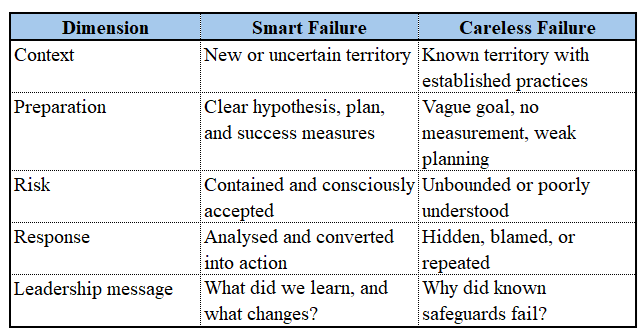
The distinction matters because leaders must foster psychological safety so individuals can report issues and suggest ideas, while ensuring accountability for negligence, misconduct, and violations of non-negotiable standards.
How To Experiment Responsibly
Responsible experimentation is a proactive approach that must be established well before any experiment takes place, rather than being a reaction to failure after the fact. To foster this disciplined approach, leaders should require teams to articulate several key components before experimenting. These components include a clear definition of the problem at hand, the specific assumption that the experiment will be testing, a well-formed hypothesis, an identification of the target audience for the experiment, a description of the minimum viable test to be conducted, the metrics that will be used to measure success, the decision criteria that will guide the next steps, and the maximum acceptable cost of the experiment. By laying out these elements, teams can transform the concept of “fail fast” into a structured methodology for gathering meaningful evidence.
Moreover, teams must design experiments to maximise learning while incurring the lowest possible costs. This often involves strategic choices such as testing with a small, well-selected group rather than a large audience, opting for a prototype that captures essential features instead of developing a full-scale product, utilising simulations to explore outcomes hypothetically, or implementing a pilot program before committing to a broader rollout. The objective behind these strategies is not to increase the frequency of failures but rather to ensure that each experiment yields valuable insights while keeping expenses to a minimum.
In addition, effective leaders play a vital role in making the framework and guidelines for experimentation transparent and accessible to all team members. They should clarify which activities are permitted for experimentation, which ones require approval, what types of risks are deemed unacceptable, and how experiment results will be reviewed and analysed. Furthermore, leaders must cultivate an environment where concerns can be raised without fear. When team members voice apprehensions, leaders should respond constructively. Punishing individuals for raising potential issues discourages open communication, creating a culture of silence where critical feedback is stifled. By fostering a safe space for discussion, leaders can encourage ongoing innovation and learning within their teams.
A Practical Framework For Learning From Setbacks
A practical framework can serve as a valuable tool for teams looking to navigate setbacks and turn them into opportunities for improvement, all without making every failure a drawn-out process. The framework should be concise, factual, and focused on actionable steps. Here are the detailed components of this approach:
Define the Decision: Clearly articulate the objective of the experiment. What specific goal were we aiming to achieve? Detail the choice that was made regarding the experiment and how it was intended to guide future decisions. Understanding the context of the decision sets the stage for analysing its effectiveness.
State the Hypothesis: Outline the hypothesis that drove the experiment. What were our expectations for the outcome, and what criteria would indicate success or failure? This includes identifying any metrics or data points that would support or contradict the anticipated results.
Establish the Facts: Gather and present the facts surrounding the situation. This includes a timeline of events: what transpired, who was involved, and any relevant data that was collected during the process. Also assess external factors that may have influenced the outcome, providing a comprehensive view beyond the team’s immediate control.
Separate Smart from Careless Failure: Distinguish between intelligent experimentation and preventable mistakes. Was this failure the result of a deliberate test conducted in a landscape of uncertainty, or a breakdown that could have been avoided based on established knowledge and protocols? This distinction is vital to learn effectively from the experience.
Identify the System Causes: Move past individual errors to examine systemic issues that may have contributed to the failure. This could involve unclear objectives, poor communication and handoffs within the team, information gaps, unrealistic timelines, inadequate tools, or insufficient training. Understanding these root causes is essential for preventing recurrence.
Extract the Learning: Reflect on the knowledge gained from the experience. What new insights have emerged that were previously unknown? Identify any assumptions that were proven to be incorrect, incomplete, or untested. This step is crucial to ensure the team can build on their experiences rather than repeat the same mistakes.
Decide the Next Action: Based on the learnings extracted, determine the appropriate course of action. Should the team persevere with the original initiative, adapt the approach based on the insights gained, halt the initiative, or escalate the issue for further attention? Clear decision-making at this stage helps guide future efforts.
Assign Ownership and Follow Up: Identify who will take responsibility for the next steps. Assign a specific person to oversee the implementation of any necessary changes, set a completion deadline, and consider any process or standard adjustments that may be required. Finally, ensure a mechanism is in place to verify that the corrective actions implemented effectively prevent recurrence.
This detailed framework underscores a fundamental principle of intelligent failure: organisations must foster an environment that encourages experimentation while also establishing structured processes for learning deeply from outcomes, whether successful or not. This balance can lead to sustainable growth and continuous improvement.
The Leadership Shift Required
The most effective leaders understand that a healthy approach to experimentation requires clear messaging. Rather than endorsing a blanket statement like “Failure is good,” they emphasise the importance of “thoughtful experimentation.” This concept recognises that while innovation and risk-taking are important for progress, allowing preventable harm and repeating mistakes is unacceptable. This distinction fosters a culture of confidence within teams, encouraging them to explore new ideas while upholding critical standards in areas such as reliability, safety, ethics, and customer trust.
To exemplify this mindset, leaders should engage their teams by asking deeper, more insightful questions. For instance, they might ask, “What assumption are we testing here?” to clarify the purpose of the experiment. Another vital question could be, “What specific indicators would lead us to halt this initiative?” This prompts a proactive assessment of risks involved. Furthermore, leaders should reflect on outcomes by asking, “What did we learn from this experience?” and “How will we adapt our approach based on these insights?” By soliciting and genuinely valuing feedback—especially unwelcome news—leaders create an environment where team members feel safe voicing concerns early. This approach is crucial because a leader’s response to negative information can significantly influence whether team members share potential issues promptly or hide them, which can lead to more substantial problems down the line.
Ultimately, the idea of “fail fast” should evolve into a more precise leadership principle: experiment intelligently. This entails understanding how to contain potential downsides, learn rigorously from each experience, and apply that knowledge effectively. This refined principle maintains the advantages of speed and adaptability inherent in quick testing while mitigating the risks of waste, recklessness, and damage to organisational culture that can arise when failures are misconstrued as mere progress. By adopting this thoughtful, strategic approach, leaders can guide their teams toward innovation in a safe, sustainable way.
Tomorrow: Are Empathetic Leaders Too Soft to Lead?
- Are Empathetic Leaders Too Soft to Lead?
- What empathy in leadership really means
- Why empathy is often mistaken for weakness
- The performance case for empathy
- Where empathy becomes ineffective
- Avoiding difficult decisions
- Lowering standards
- Taking on employees’ emotional burdens
- Compassionate accountability: the better model
- How to lead with empathy and authority
#WorkplaceCulture, #EmployeeExperience, #PerformanceManagement, #Leadership
