
Understanding the Facts about Being Overweight is an excerpt from my book, Choices Have Consequences: Navigating Life’s Path.
Doctors and Health Coaches have confirmed that a large number of overweight and obese individuals tend to choose options like laparoscopic surgery, weight loss medication, or prescription medication to address their condition instead of making lifestyle changes.
Given the validity of these observations, I sought an explanation for why the great majority of people, regardless of background or circumstances, tend to opt for the easy weight-loss solution that delivers short-term results but inevitably fails.
I delved into the psychological mechanisms that govern decision-making in the human brain.
The intricate workings of our brain, including neural circuits, connectivity, knowledge maps, and prior experience, shape our decision-making processes. This understanding not only sheds light on everyday choices but also provides valuable insights into conditions such as addiction, anxiety disorders, and other psychiatric conditions.
Understanding how our brains make decisions and handle challenges related to health, mental well-being, work-life balance, relationships, and beliefs is essential to reflect on our resilience and adaptability. This topic goes beyond being overweight to encompass the consequences of daily choices.
So, instead of looking at the problem from the perspective of a person who is overweight, trying to understand why they make the choices they do, I started looking at it from the opposite perspective. This shift in focus is crucial, as it enables us to explore how the brain makes decisions and how we can alter the decision-making process.
Things Are Not Always As They Appear
We have all grown up in a world that tells us we need to present ourselves a certain way. The best way to describe it is to imagine yourself standing on the footpath looking at the front of a magnificent house.
The lawns of this house are manicured, and the edges are trimmed to perfection; the garden bed balances colourful flowering shrubs with tall, majestic trees. The house is freshly painted, and the front door is truly magnificent. The double centre-opening door is wide and made of solid, perfectly polished timber.
We have grown up understanding the importance of the face we present to the world and the need to hide the less attractive aspects of ourselves from our family, friends, associates, and work colleagues. Why?
Rejection and Judgment
Many individuals fear that revealing their flaws will lead to negative judgments from others. This fear can stem from past experiences where vulnerability was met with criticism or rejection. As a result, people may choose to conceal their imperfections to maintain relationships and avoid potential emotional pain. It took me 76 years and numerous visits to my psychologist before the words my father used when I was twelve, the nine words that drove me to attempt suicide in 2014, came to mind in August 2024, before the penny dropped. I understood it could all be summed up in just one word, “REJECTION”.
Social Conditioning
Society promotes an unrealistic standard of perfection, pressuring individuals to conform. This conditioning can create a belief that flaws are unacceptable, compelling people to conceal their true selves to fit in and be accepted. The prevalence of social media exacerbates this issue, as people tend to share only their best moments, further perpetuating the idea that everyone else is living a flawless life.
Superficial Connections
When individuals mask their vulnerabilities, something I have managed to do with great perfection, they often engage in surface-level interactions rather than forming deeper connections that provide the trust required to create close, long-lasting friendships.
Self-Perception and Self-Worth
Individuals often attach their self-worth to their perceived perfection, believing they must be flawless to be worthy of love and respect. This mindset can create a cycle of anxiety and self-criticism, making it difficult for individuals to embrace their true selves. From my perspective, I lived in denial that I had any issues, and when I had dark moments, I found ways to overcome feelings of low self-worth.
Path to Acceptance
Embracing imperfections can lead to greater freedom and authenticity in relationships. Acknowledging flaws can foster deeper connections and mutual understanding, making individuals more relatable and empathetic. Vulnerability is a source of strength, and accepting one’s imperfections can enhance personal growth and relationships. It takes courage to be vulnerable and accept imperfections, but it can inspire and motivate.
Words Become Our Armour
Words often conceal insecurities as a defence mechanism against vulnerability and judgment. When we feel uncertain about ourselves or fear rejection, we sometimes resort to language that projects confidence or superiority, hoping to mask our internal struggles. This façade can, strangely enough, draw more attention to the very insecurities we seek to hide, as the effort to suppress them often leads to exaggerated displays of confidence or passive-aggressive comments.
Acknowledging and accepting insecurities can foster genuine connections and promote personal growth, ultimately leading to a more fulfilling life and deeper, more fulfilling relationships.
Back to the Perfect House
So here you are, looking at what you believe to be the perfect house. But it’s not until you walk through the front door that you discover all is not as it appears. The floors are dirty, the walls are marked, and the paint is peeling in sections. The carpet on the stairs is ragged and lifting in parts of the stairway. The handrail is damaged and needs repair. The kitchen sink is filled with dirty dishes, cups, and cutlery, while the benches appear not to have been wiped down for some time.
Now, some of what I have described may have touched a nerve or given you cause to think that most of you don’t believe your house is as bad as I have described. Still, the reason is that we have all been conditioned to think we must put on our game face to do whatever we need to do.
For what I have just written to be truly believed, I will be brave enough to share with you my less-than-perfect side, the part of me I have hidden from everyone, and the things I am truly ashamed of.
I have lived in denial that my health was a problem.
I have hidden my depression until it caused me to try to take my Life, plan a second attempt and experience the dark moments again.
My Life has been built on deceit; the front of my house appears to be the one I described, but inside, it is a total mess.
Work-life balance is a lovely, catchy phrase, but the reality is that I have lots of people I am friendly with, but I have very few true friends.
My personal Life is just that personal. No one, not even my wife, truly knows how I feel. I hide it all, and if Jacqui and my psychologist ever get together and exchange notes, I am in trouble.
My business relations are littered with stories of people who promised me the world but never delivered, and I don’t think I ever intended to deliver on their word. I am guilty of never challenging them.
My belief systems have been in front of the house for most of my Life. While it is true that what I presented and delivered were very similar, I have never really believed in myself until my dark thoughts returned. At that point, I convinced myself I needed help and found a psychologist to help me find out what was always holding me back—my darkest secret.
So, you see, I am just like you; what I present, like what I feel and how I cope with those feelings, is the story I so truthfully want to share with you in my books. Why? Because I have always been a better coach than ever a player. It’s how my brain works; it’s the journey my thoughts take me on whenever I sit and talk with someone about their issues or darkest moments.
I am not a remarkable man, but I have been told by many that my health journey, indeed my story, is impressive in that I have survived stage-4 cancer, a heart attack, stroke, kidney disease, skin cancer, and numerous other health issues that brought me close to Death on three occasions and damaged my relationship with my wife and daughters.
In my book, “Life is a Gift – Health is a Choice,” I share a story about my health struggles, the choices I made, and the consequences of those choices.
While liaising with my editor regarding the book’s final editing, I discovered so much more that I wanted to share with people about the importance of their health choices. While not part of my original plan, the subtitle ‘Choices Have Consequences’ epitomises the additional content I wanted to include in my book during the editing phase before publication. I believe this additional content needs to be communicated to people seeking to improve their health and live the best possible quality of Life, so I decided the subtitle would be the title of my next book.
I watched my mother and stepfather both die of lung cancer, my father die of a heart attack, and my mother-in-law and father-in-law die of cancer. The one thing that was common in all their struggles was the desire to live longer than their medical conditions would allow.
The one thing we all have in common with my relatives who have passed is that we will all fight for an additional year, month, week or even day, and we will do whatever we have to do.
At this point, it’s never about improving the quality of our lives. It’s about surviving.
So here is my question to you, to all of humanity. Why do you wait until it’s too late to change things? Why, hundreds of times every day, do you all make choices about what you eat, drink, smoke, inject, and consume that years from now will compromise your health and ultimately shorten your Life? Why do you sit instead of standing, lounge around instead of exercising, drive instead of walking, and take the elevator or the escalator instead of walking the stairs? Why do you allow your Life to be filled with negative thoughts and doubt about your abilities and seek the approval of others when the only person that matters when it comes to all these things is YOU?
Life expectancy in 1820 was 40-42 years for both men and women; 200 years later, it had increased to 72.6 years for men and 73.2 years for women. While we can attribute this dramatic change to healthcare advances, such as improved sanitation, clean water access, nutrition, antibiotics, vaccines, and other medical technologies, one in every eight people in the world is obese.
The Choices we Make Every Day Have Consequences
My message is simple: While our life expectancy has changed in the last 200 years, the choices we make will either push us into the 1 in 8 people who are obese category or allow us to live much longer, more meaningful lives.
We live in a world today where it is being promoted that we can live longer than ever before and that Death has now become a Choice.
My mental and physical health journey is testimony to the fact that the consequences of our choices compromise our health. However, it’s still possible if you change your lifestyle habits and, with the help of medical professionals and medication, control the risks while healing your body.
Choices Have Consequences.
My loving wife, best friend, and the only person apart from my phycologist who knows everything about me (I am going to be in big trouble if they ever meet and exchange their knowledge of me) said, “God has filled your life with health challenges and the ability to overcome so many of them; you better start working out what he wants you to do with these gifts.”
Jacqui, I have worked it out. It’s to tell my story to as many people as God has given ears to listen and make a difference in their lives.
It has been said that you can live three months without food, three days without water, 3 minutes without air, but you can live for 3 seconds without hope.
Sufficient evidence is available on the internet to support the notion that excessive weight is detrimental to one’s health. I should know because it’s almost a case of you naming it, and I have had it. The fantastic fact associated with that statement is how long I lived in denial that my excess weight was a cause of my medical conditions, and the fact that I refused to accept the proposition that I could lose my Life as a consequence of that denial.
This chapter is not designed to scare you into action, because I know that the only thing that will make you change your lifestyle habits is hearing it from your doctor’s mouth. The words are most probably not going to be “change or” or “there’s nothing more we can do”. At that point, I know you will be listening and fully understand that your choices have consequences.
According to the WHO, recent global estimates, approximately 43% of adults worldwide will be overweight in 2022, with 2.5 billion adults aged 18 years and older being overweight, including over 890 million adults living with obesity.
According to Grandview Research (n.d.), the global weight loss supplement market was valued at USD 29.96 billion in 2023 and is projected to grow at a compound annual growth rate (CAGR) of 13.70% from 2024 to 2030. The rising cases of obesity and related health ailments, such as cardiovascular diseases, diabetes, and hypertension, are expected to drive product demand. The prevalence of obesity has been increasing globally, and this trend has contributed to market growth.
According to the WHO (World Health Organisation), in 2022, a concerning number of children under the age of 5 experienced overweight issues, totalling 37 million. In addition, the statistics reveal that over 390 million children and adolescents aged 5 to 19 years encounter weight challenges, with 160 million of them struggling with obesity.
Being overweight or obese can lead to numerous health problems, including:
- Type 2 Diabetes: High blood glucose levels due to insulin resistance.
- Cardiovascular Diseases: Increased risk of heart disease, high blood pressure, and stroke.
- Musculoskeletal Disorders: Conditions like osteoarthritis due to extra stress on joints.
- Certain Cancers: Higher risk of cancers such as breast, colon, and endometrial cancer.
- Sleep Apnea: Obstructive sleep apnea due to excess weight around the neck.
- Gallbladder Disease: Increased risk of gallstones and cholecystitis.
- Kidney Disease: Higher risk of chronic kidney disease.
- Mental Health Issues: Increased risk of depression and anxiety.
Cardiovascular diseases (CVDs) are the leading cause of Death globally. In 2019, nearly 18 million people died from cardiovascular diseases worldwide, accounting for about one-third of all global deaths. In Australia, CVDs claim one Life every 12 minutes.
The global death rate from CVD varies widely between countries. In 2019, the rate ranged from less than 80 per 100,000 people in countries such as France, Australia, and Canada to over 500 per 100,000 in Afghanistan, Sudan, and Mongolia. Meanwhile, in the United States, the age-standardised death rate from cardiovascular diseases has declined dramatically from over 500 per 100,000 people in 1950 to less than 150 per 100,000 in 2020.
As of 2022, in the United States, the death rate from heart disease specifically was 210.9 per 100,000 population. While the absolute number of CVD deaths has increased due to population growth and aging, many countries have seen declines in age-standardised death rates due to improvements in prevention, screening, and treatment. Globally, CVDs account for approximately 32% of all deaths worldwide, with an estimated 17.9 million deaths in 2019. In Australia, CVDs account for one in four (25%) of all deaths.
Diabetes is a significant health concern in Australia. Over 4,400 amputations occur annually dueDisease disease, making it the second-highest rate in the developed world. In 2005, more than 1,000 individuals with diabetes died directly from foot ulcers and lower limb wounds, accounting for about 8% of all diabetes-related deaths. The death rate for individuals with type 2 diabetes is significantly higher than in the general population.
The economic burden of diabetes is substantial, costing the Australian economy approximately $14.6 billion annually. Roughly 1.7 million people in Australia have diabetes, including all types, and an estimated 2 million Australians have pre-diabetes and are at high risk of developing type 2 diabetes in the future.
Evidence suggests that up to 58% of high-risk cases of type 2 diabetes can be prevented. Furthermore, 280 Australians are diagnosed with diabetes each day, and globally, diabetes caused 4.2 million deaths in 2019, representing 11.3% of global mortality. These statistics underscore the significant mortality risk associated with type 2 diabetes.
Death rate of respiratory diseases as a percentage of all respiratory diseases: Respiratory diseases have a significant impact on global mortality. Here are some key statistics:
In 2002, respiratory diseases accounted for 20% of all causes of Death worldwide, with an estimated mortality rate of 183 per 100,000 population.
In 2022, respiratory conditions were cited as the underlying and associated cause of 54,776 deaths in Australia, representing 29% of all deaths.
Chronic respiratory diseases, including COPD and asthma, contributed to 7% of all deaths worldwide in 2017, amounting to an estimated 3.9 million deaths.
These figures highlight the significant impact of respiratory diseases on global mortality.
The death rate statistics foDisease Disease:
In 2017, chronic kidney disease (CKD) caused 1.2 million deaths worldwide, which accounted for 4.6% of total mortality.
In the United States, nephritis, nephrotic syndrome, and nephrosis ranked as the 9th leading cause of Death, with a death rate of 17.4 per 100,000 population.
In Australia, chronic kidney disease (CKD) was responsible for a significant 11% of all deaths, contributing to approximately 22,000 deaths in 2022.
These statistics underscore the significant impact of kidney disease on mortality rates but also point to the potential for substantial change, as many cases are preventable.
Cancers
Death Rates: The percentage of total cancer deaths for colon, breast, endometrial, kidney, and esophageal cancers is as follows:
For Colorectal Cancer, the death rates increase with age. It is the second leading cause of cancer death in the United States. However, due to significant advancements in cancer research, the death rate was 12.9 per 100,000 men and women per year based on 2018–2022 deaths, age-adjusted, showing a decline in recent years.
Detailed below are the death rates as a percentage of total cancer deaths for colon, breast, endometrial, kidney, and esophageal cancers:
Colon Cancer: Colon cancer is the fifth most deadly cancer, accounting for 5.8% of all cancer deaths globally. In the U.S., it is expected to cause about 53,010 deaths in 2024.
Breast Cancer: A Leading Cause of Cancer Death Among Women: It is the leading cause of cancer death among women, with an estimated 42,250 deaths in 2024 in the U.S.
Endometrial Cancer: Endometrial cancer is less common, with an estimated 13,250 deaths in the U.S. in 2024.
Kidney Cancer: Kidney and renal pelvis cancers are expected to cause about 14,390 deaths in 2024 in the U.S.
Esophageal Cancer: A Highly Fatal Cancer: Esophageal cancer, though less common, is highly fatal, with an estimated 16,410 deaths in 2024 in the U.S.
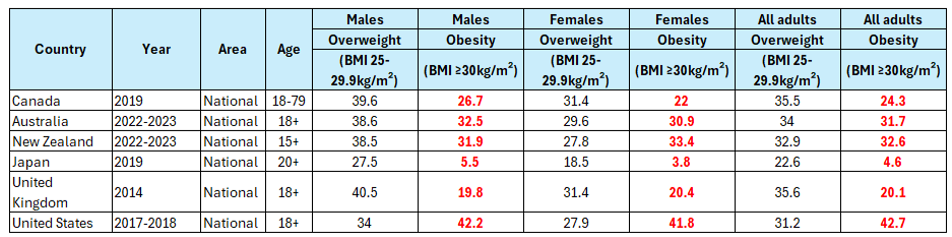
The statistics in the table above can be found on (ObesityWorld), which indicates the prevalence of adult obesity in Canada, Australia, New Zealand, Japan, the United Kingdom and the United States, with a BMI of 25-29.9 and greater than 30 for both men and women.
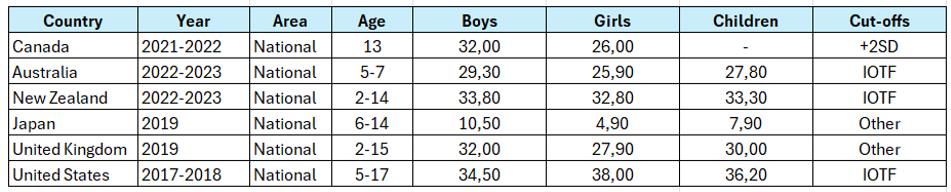
The statistics in the table above indicate the prevalence of childhood obesity in the same regions, confirming that, as adults, we are setting deplorable examples for our children.