
Asynchronous Leadership: Communicating Clearly When Everyone Works at Different Times. Asynchronous leadership is a modern approach to managing teams spread across locations or operating on flexible schedules. This leadership style emphasises clear, durable communication, allowing team members to engage and contribute at their convenience instead of expecting everyone to be available at the same time. This accommodates different work hours and time zones while fostering accountability and productivity, as decisions, priorities, and progress remain transparent to the entire team.

Understanding Asynchronous Leadership
At the heart of asynchronous leadership is asynchronous communication, defined as any exchange of information that does not require the immediate presence of all parties involved. This can take many forms: written updates through emails or project management tools, shared documents that allow collaborative input, task comments that facilitate dialogue, and recorded videos or voice notes that convey complex ideas succinctly without requiring real-time interaction. With asynchronous communication, the leader’s role shifts from merely relaying information during meetings to curating an easily accessible repository of knowledge for all team members. This includes clarifying the context around decisions, stating conclusions clearly, and outlining next steps to eliminate ambiguity.
This leadership framework is especially advantageous for teams across different time zones, as it lets individuals participate and contribute at times that suit their schedules. It also helps accommodate those who prefer uninterrupted focus time, reducing the need for frequent, disruptive meetings. Instead of waiting for a designated meeting to stay informed, team members can stay updated by reviewing the latest communications or documents at their own pace. This proactive accessibility empowers them to respond and act more quickly, which, in turn, improves the team’s overall efficiency and dynamism.
By implementing asynchronous leadership, organisations can cultivate a more inclusive and flexible work environment, where every member can engage meaningfully without the constraints of traditional time-bound communication methods.
Guidelines for Effective Asynchronous Updates
When crafting updates, ensure they can stand alone and provide clear understanding without follow-up discussions. Here’s a more detailed structure to follow:
Context: Start by outlining what’s happening, why it matters, and any changes. This section should set the stage and provide enough background for readers to understand the update’s relevance.
Decision: Clearly state what has been decided, what has been proposed, or any elements that require a decision from the recipients. Keep this straightforward and unambiguous to avoid confusion about what you’re requesting or communicating.
Rationale: Explain the reasoning behind the decision made. This includes why the chosen course of action was selected over alternatives, what trade-offs were considered, and any risks associated with the decision. This section provides transparency and helps readers understand the decision-making process.
Action: Specify who is responsible for the next steps. Clearly delineate the actions that need to be taken, who is accountable for each one, and any collaboration required to move forward. This ensures that everyone knows their roles in the process.
Deadline: Indicate the timeline for when actions or responses are expected. Be specific about deadlines to create urgency and clarity about timeframes. This allows the team to plan and prioritise better.
For example, instead of a vague statement like, “We are reconsidering the launch date,” a leader could provide a comprehensive update as follows:
Context: The vendor testing timeline has been extended and will conclude two days later than originally scheduled. This delay is significant as it impacts our launch readiness.
Decision: We have agreed to move the customer launch date from November 12 to November 14.
Rationale: This decision allows sufficient time for thorough security validation, ensuring we maintain product integrity and customer trust. While delaying the launch may affect initial sales projections, it significantly mitigates the risk of operational failures post-launch.
Action: The Marketing team will revise the launch announcement to reflect the new date, and the Engineering team will confirm testing completion by November 10.
Deadline: Please escalate any concerns regarding this change by 5 PM tomorrow.
Additionally, clearly state the type of response required from the recipients, such as “For acknowledgment,” “For feedback by Thursday,” or “No response needed unless you identify a potential risk.” This prevents any ambiguity about whether silence indicates agreement, oversight, or disagreement, ensuring effective communication throughout the team.
Establish a Single Source of Truth
In any project, having a single source of truth is essential for maintaining clarity and efficiency. This is defined as the designated location where all crucial information, including project status, critical decisions, responsible owners, deadlines, and key documents, is stored and easily accessible to all team members. This repository could take several forms, such as a dedicated project management tool (like Asana, Trello, or Monday.com), a team wiki, or a structured shared drive. The most important aspect is that everyone on the team knows where to look first for information, reducing confusion and streamlining communication.
When information is spread across platforms—chat threads, emails, personal notes, or meeting recordings—teammates often waste valuable time searching for updates or historical context. This fragmentation can lead to misunderstandings and may cause actions based on outdated or incorrect information. To mitigate these risks, leaders should proactively designate a single source of truth as the go-to location for all significant project-related work. This includes maintaining project plans, decision logs, meeting notes, policy documents, briefs, and status dashboards in this central hub.
A practical norm to adopt is: “If it impacts the project, it belongs in the project workspace; chat is reserved for discussion rather than serving as a permanent record.” By implementing this guideline, teams create a transparent and accountable environment where a clear trail of decisions is established. This practice reduces reliance on individual memory or private messages. It fosters a culture of collaboration and inclusion, where every team member has access to the same accurate, up-to-date information.
Set Response-Time Expectations
Asynchronous communication does not mean “reply whenever.” It involves agreeing in advance on how quickly different channels and request types should receive a response. Without these explicit expectations, individuals may feel ignored or pressured to monitor messages constantly.
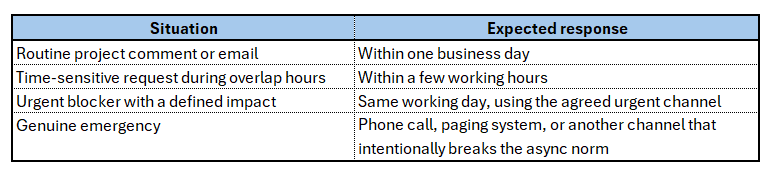
Escalation paths are crucial to effective communication. Clearly define what qualifies as urgent, identify who handles escalations, specify which communication channel to use, and designate a backup decision-maker if the primary owner is unavailable. For example: “If a production issue impacts customers and the on-call engineer has not responded within 30 minutes, notify the engineering manager. If they are unavailable, reach out to the duty executive.” This approach ensures that true emergencies are addressed quickly, while preventing every message from being treated as urgent.
Rethinking Status Meetings: Transitioning to Written Updates
In many organisations, recurring status meetings have become a staple for sharing information, where team members provide updates on completed tasks, upcoming priorities, challenges faced, and items needing attention. However, these meetings often consume valuable time and may not always lead to productive discussions. Therefore, it’s worth considering a shift from these traditional meetings to structured written updates shared within the project workspace.
A well-crafted written update can include several essential components. For instance, it should outline recent accomplishments, highlighting what has been achieved since the last update. Next, it should specify upcoming priorities, detailing what tasks are on the horizon and their expected timelines. Additionally, it’s crucial to identify any blockers – those obstacles that may hinder progress – and to clarify any decisions required from the team leaders. To foster collaboration, it is also helpful to include questions for team members and links to relevant documents or previous work that provide context or support for the updates.
The benefits of implementing written updates are significant. First and foremost, they allow team members to prepare their thoughts thoroughly, leading to higher-quality information being shared. Written documentation also lets you include direct links to evidence, making it easier for colleagues to verify claims or delve deeper into specific topics. Moreover, unlike meetings, which can be missed or forgotten, written updates create a searchable history that can be invaluable for onboarding new team members, helping them get up to speed quickly without sifting through countless meetings or relying on memory.
To make this transition effectively, start small by replacing one recurring status meeting at a time. Post the written update before the old meeting’s scheduled time. During this period, encourage team members to review the update and add their comments or questions asynchronously. This approach boosts engagement and lets team members contribute at their own pace, accommodating varied schedules.
After the initial transition, consider keeping a brief live session to address any unresolved issues or questions that arise from the written update. This focused approach can lead to more meaningful discussions and decision-making. Over time, if the written update process proves effective and the team adapts, you may need the original meeting less, which can use your team’s time and resources more efficiently.
In conclusion, moving away from status meetings in favour of written updates not only streamlines communication but also enhances clarity, engagement, and efficiency within the team. By implementing this change thoughtfully, teams can foster a more productive and collaborative environment.
Utilising Recordings for Enhanced Tone and Nuance
While written communication can be efficient, it often fails to capture the full range of tone and emotion needed to discuss complex visual or emotional topics. When clarity and connection matter most, short videos or voice notes can significantly improve understanding. This is especially true for leaders who need to articulate their thought processes, show visual elements on-screen, deliver sensitive feedback thoughtfully, or provide detailed context that might otherwise require extensive written communication.
For instance, a two-to-five-minute recorded walkthrough can be an invaluable tool for illustrating various subjects, such as navigating a dashboard, explaining a product change, addressing a customer issue, or outlining a process problem. Such recordings help convey vocal nuances and inflections that are often lost in written text. Furthermore, letting viewers pause, rewind, or watch at an accelerated speed lets them engage with the material in a way that fits their schedule and learning style. They can also provide their thoughts or questions in the comments, fostering a more interactive and engaging environment.
To maximise the utility of these recordings, store them alongside the relevant documents or tasks. This keeps them easily accessible as part of the shared record, rather than burying them in a chat thread where important information can be overlooked or forgotten.
Recordings should complement written communication, not replace it. A best practice would be to pair a concise video with a succinct written summary that outlines key decisions, identifies action items, and sets deadlines. This approach lets team members quickly skim the essential points and decide whether to dive deeper by watching the recording for a more comprehensive understanding. By integrating both mediums, leaders can foster clearer communication and stronger engagement within their teams.
Choose Sync Deliberately
The primary objective is not to eliminate meetings but to approach them intentionally, ensuring live discussions are reserved for situations that truly benefit from real-time interaction. Some scenarios require synchronous communication: complex trade-offs, sensitive feedback, conflict resolution, creative brainstorming, crisis management, and relationship-building all thrive in environments where participants can engage dynamically. In these contexts, the ability to ask questions, gauge reactions, and quickly build shared understanding becomes invaluable.
To decide whether a meeting is appropriate, use this straightforward guideline: if the main purpose is to convey information in a one-directional way, move it to an asynchronous format. On the other hand, if the meeting intends to make difficult decisions, resolve disagreements, or build trust among team members, hold it live.
Even meetings that require real-time interaction still need structure and efficiency. Before the meeting, distribute a clear agenda and any necessary pre-reading materials. This preparation helps participants arrive informed and ready for productive discussion. After the meeting, document decisions and action items thoroughly. Capture these records in a centralised location that serves as a single source of truth, ensuring everyone stays aligned on outcomes and next steps. This careful planning helps teams maximise the effectiveness of synchronous interactions, fostering a more collaborative and engaged work environment.
Establishing a Leadership Habit for Asynchronous Communication
Successful asynchronous leadership is not just a one-time effort; it requires leaders to model effective communication practices consistently. To cultivate this habit, leaders should prioritise several key actions:
Writing Clear Updates: Leaders must communicate updates concisely and coherently, ensuring that team members clearly understand the message and context. This may involve structuring updates with bullet points or headings and providing relevant background information.
Linking to the Source of Truth: Whenever possible, leaders should reference specific documents or resources with the most accurate, up-to-date information. This approach promotes transparency and empowers team members to find answers independently, without constantly needing to consult the leader.
Respecting Agreed Response Windows: Leaders should follow established response timelines. By doing so, they model respect for each team member’s workload and time, helping everyone manage priorities effectively without the stress of unexpected demands.
Avoiding After-Hours Pressure: Leaders should protect their team’s work-life balance by refraining from sending requests or communications outside normal working hours, unless necessary. This practice fosters a culture where employees feel comfortable disconnecting and recharging.
Escalating Through the Defined Path: Rather than seeking immediate responses or dictating quick solutions, leaders should encourage the team to follow established communication processes. This involves using defined escalation channels, which nurtures an environment where issues are addressed thoughtfully and collaboratively.
By honouring these norms, leaders empower their teams to adopt the same principles, creating a cohesive culture built around effective asynchronous communication.
This approach offers significant benefits. Team members spend less time coordinating and more time engaged in productive, meaningful work. This increases autonomy and focus, as individuals can make decisions and take action based on clear, easily accessible information. Furthermore, transparent communication helps build trust within the team. As a result, valuable real-time interactions can be preserved for discussions where human presence truly adds value, such as brainstorming sessions or complex problem-solving scenarios. Essentially, a well-established asynchronous leadership habit not only improves daily operations but also supports a thriving organisational culture.
Tomorrow’s post will be: Knowledge Transfer Before People Leave: Capturing Experience Without Creating Bureaucracy.
