
Defining Personal Values and Goals: Personal values act as an essential internal compass, helping individuals define what matters most to them in various aspects of life. These core principles not only shape your beliefs but also influence your behaviours and decision-making processes. By taking the time to clarify and articulate your values, you empower yourself to make thoughtful and intentional choices that align with your true self.
This understanding plays a significant role in cultivating authentic relationships, as it fosters transparency and honesty in your interactions with others. When you are clear about your values, you can engage with people who share similar principles or challenge you in meaningful ways, thereby enriching your connections.
Moreover, recognising your personal values helps you prioritise how you allocate your time and energy. It enables you to focus on pursuits and activities that resonate with what you deem genuinely meaningful, leading to a more fulfilling and purpose-driven life. Overall, a well-defined set of values serves as a foundation for personal growth, guiding you through life’s complexities and helping you navigate challenges with confidence and integrity.
Defining Personal Values and Goals
Personal values are the core beliefs and guiding principles that shape our identity and influence our behaviour every day. They serve as the bedrock of who we are and dictate how we choose to engage with the world around us. These values are not simply whims or societal expectations; rather, they are intrinsic motivators that deeply reflect our character and worldview. By understanding our values, we gain insight into what truly matters to us and how we want to navigate life’s complexities.
It is crucial to distinguish between personal values and goals, as people often conflate the two. While both play significant roles in personal development, they have fundamentally different functions. Personal values represent the ongoing directions we strive to embody in our lives, guiding our everyday choices and interactions. In contrast, goals are specific, measurable outcomes we set for ourselves, often characterised by clear endpoints.
To further clarify these differences, let’s examine the dimensions of personal values and goals:
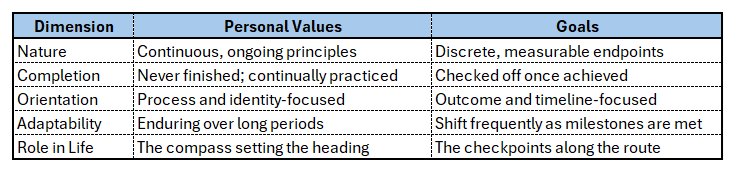
Goals serve as checkpoints along the route of our personal journeys, giving us targets to aim for and celebrate as we achieve them.
Understanding the distinction between personal values and goals is essential for anyone seeking to live a balanced and fulfilling life. A goal provides a specific target, offering motivation and direction. However, our values ensure that the targets we pursue are genuinely worth striving for, keeping us aligned with our true selves and principles. By appreciating this relationship between values and goals, we can cultivate a more meaningful approach to personal growth and development.
Values have always been a passion of mine. I’ve dedicated time to identifying my personal values and understanding how they influence my daily decisions. To support this journey of discovery, I researched the topic extensively and created an Excel spreadsheet. Typically, I charge $10.00 for access to download this spreadsheet, but for the next seven days, I am offering it for free. You can download it using the following link.

How Values Shape Choices and Relationships
Core values are foundational pillars that significantly influence our daily decision-making. They act as an internal compass or evaluation filter, guiding us at crucial junctures in our lives. Whether we face important choices about our careers, finances, or lifestyle changes, assessing options through the lens of our deeply held values helps us choose paths that lead to genuine, long-term satisfaction rather than short-term convenience or immediate gratification.
When we make decisions that align with our core values, we open the door to a life characterisedcharacterised by psychological integrity and authenticity. This alignment helps to reduce the mental and emotional friction that often stems from impulsive or reactive decision-making. By grounding our choices in our values, we create a more mindful approach to life that encourages reflection and intentionality.
In personal and professional relationships, our values play a crucial role in determining compatibility and fostering mutual trust. They set the stage for the boundaries of communication and trust that we build with others. When individuals share similar core principles, they can establish strong relational foundations built on understanding and empathy.
Conversely, when value differences are unacknowledged or ignored, they can lead to persistent friction and misunderstandings that jeopardise relationships.
To navigate both personal and professional landscapes effectively, consider the following strategies:
Choosing Projects or Employers: Actively seek out opportunities, projects, or employers whose missions resonate with your ethical standards. This alignment ensures your work is meaningful and fulfilling, not simply a means to an end.
Establishing Boundaries: Establish firm interpersonal boundaries that prioritise respect, honesty, and autonomy. Clearly defined boundaries help to maintain healthy relationships and create an environment where communication can flourish.
Selecting Social Circles: Invest time in forming social circles that reflect your commitment to mutual growth, empathy, and support. Surrounding yourself with individuals who share similar values can strengthen belonging and motivate collective progress.
Managing Conflict: When conflicts arise, focus on understanding the underlying principles and values at play rather than getting caught up in surface-level disagreements. By addressing the core issues, you can foster more productive discussions and find resolutions that respect everyone’s values.
By consciously incorporating our core values into our decision-making processes and relationships, we can create a more harmonious life that aligns with our true selves, enhancing both personal fulfilment and relational depth.
Identifying Values and Resolving Conflicts
Uncovering your authentic values is a deeply introspective process that involves examining significant moments in your life—those instances that have shaped who you are and what you stand for. This can include your peak achievements, routines that bring you fulfilment, and even periods of deep frustration. Reflecting on your peak experiences is crucial, as these moments often reveal what truly invigorates you and gives your life meaning.
Conversely, times of intense anger or resentment can shed light on where your personal boundaries have been crossed or where your core values have been compromised. This kind of reflection helps you pinpoint the values that resonate most deeply with you.
Additionally, consider the qualities you admire in mentors or historical figures. By analysing the traits and characteristics that you find compelling in others, you can further clarify what you value most in your own life. This admiration can act as a mirror, reflecting the values that you aspire to embody.
Life often presents us with conflicts between two or more important values, requiring us to navigate these dilemmas thoughtfully. For example, you may find that your strong desire for security conflicts with a yearning for adventure when considering a new career opportunity. Alternatively, the value of autonomy might clash with the need for collaboration in a team-oriented environment. Resolving these tensions demands a mature understanding that values operate within a dynamic hierarchy, where the context of a situation determines which principle should take precedence.
To effectively manage these conflicts, consider the following steps:
Clarify Non-negotiable Values: Begin by identifying which value is non-negotiable in the specific context you’re facing. This requires a clear understanding of your priorities and what you cannot compromise on.
Identify Potential Compromises: Explore possible solutions that honour both competing values to a satisfactory degree. This might involve negotiating how each value can be respected within the situation, allowing for a balanced approach that does not entirely sacrifice one for the other.
Acknowledge Emotional Discomfort: Understand and accept the emotional discomfort that often accompanies the decision-making process. Choosing one positive value over another can lead to feelings of guilt, stress, or anxiety. Recognising this discomfort is an important step in processing your choice.
Focus on Long-term Alignment: Instead of seeking immediate comfort, let long-term alignment guide you. Consider how your decision will affect your overall life vision and values in the long run. This perspective can help you make more deliberate choices that are consistent with your authentic self.
Ultimately, navigating the complexities of competing values is a skill that requires self-awareness, reflection, and a willingness to embrace the ongoing journey of personal growth.
Practical Decision-Making Worksheet
When faced with significant life or career decisions, it’s essential to translate your abstract values into concrete actions. A structured evaluation process can lead to more informed, deliberate choices. This framework allows you to systematically assess your options while ensuring they align with your core principles.
Step-by-Step Values Worksheet
Define the Decision: Start by clearly and objectively stating your specific choice or dilemma. Describe the context and any relevant details that may influence your decision. The goal is to create a focused statement that captures what you’re facing.
List Your Top 3–5 Core Values: Reflect on the principles that hold the most significance in your life, particularly in relation to this decision. Common values may include Integrity, Growth, Family, Autonomy, Health, or Balance. Choose the values that resonate most deeply with the situation at hand, and that will guide your decision-making process.
Map the Options: Identify the primary courses of action available to you. List at least three to five distinct options, breaking them down as clearly as possible. Consider different paths you could take and explore alternatives that may not be immediately obvious.
Evaluate Value Alignment: For each option listed, score the degree to which it aligns with your core values. Use a scale of 1 to 5, where 1 indicates weak alignment, and 5 indicates strong alignment. This evaluation will help you visualise how well each choice reflects your guiding principles.
Analyse the Trade-Offs: Carefully consider any potential value conflicts or sacrifices associated with each option. Note the implications of choosing one path over another, including any compromises on your values that may arise. Understanding these trade-offs is crucial for making a well-rounded decision.
Formulate the Action Step: After completing the evaluation and analysis, select the option that has the highest overall integrity score. This option should best align with your core values. Once you’ve made your choice, outline the immediate steps you need to take to begin implementing it. Be specific about your next actions to ensure clarity and direction.
By applying this structured approach, you can ensure that your decisions are grounded in long-term purpose and aligned with your core values, rather than driven by impulsive reactions or short-term gains. This thoughtful process empowers you to make choices that contribute to your overall well-being and fulfilment.
